
Best Dog Crates for Staffies: Anxiety, Back-Seat Travel & Safe Boot Transport
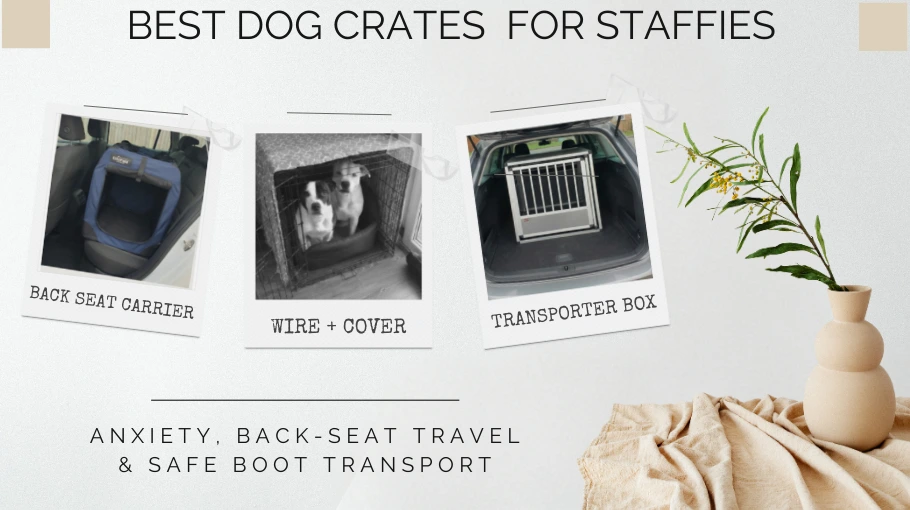
Finding the right dog crate for a Staffy isn’t as simple as grabbing a “puppy training crate” and hoping it lasts. Most puppies outgrow those quickly — and some crate types simply aren’t built for Staffy strength or energy.
Whether you’re dealing with anxiety, back-seat travel, or a dog who needs structure in the boot, the best dog crate is the one matched to your dog’s behaviour and your lifestyle. Some crates are brilliant long-term investments… others won’t survive the first week.
Discover the Best Dog Crates (& Help to Decide if It’s Right for Yours)
The Different Types of Dog Crates (and Which Owners They Suit)
Crates are built for different behaviours and use-cases. Some dogs chew, some head-butt the door, some try to get their paws through wire gaps, and others get worked up when fully enclosed. Whatever your dog’s quirks, there’s usually a crate design that solves it.
Wire / Metal Crates (Most Common Choice)
Durable, affordable, and well-ventilated. They fold flat and are easy to clean. Most Staffies settle well in wire crates because they can still see the room without feeling shut away.
We use this style ourselves, with three sides covered. Limiting their field of view helps them wind down quicker when visitors are around.
Best for: everyday use, training, and dogs who feel calmer when they can see what’s going on.
Plastic / Hard-Sided Crates
More enclosed and den-like, which some dogs find soothing. Brands like the PetMate Sky Kennel are airline-approved and built from thick, durable plastic.
These can help anxious dogs, but Staffies tend to run warm, and plastic heats up faster than wire. Good ventilation is essential.
Best for: dogs who prefer privacy and enclosed spaces — less ideal for heat-sensitive breeds like Staffies.
Soft-Sided Crates (Travel / Secondary Crates)
Lightweight, portable, and padded. These are often more comfortable than plastic crates for back-seat travel, especially on warm days. They do require a dog who won’t chew or scratch their way out.
Best for: short trips with calm, well-trained dogs who don’t test boundaries.
Heavy-Duty Crates (Niche / Behaviour-Specific)
Reinforced metal designed for strong, anxious, or escape-prone dogs. Extremely secure and very reliable — though heavy and expensive.
When fitted properly, they make excellent car-boot setups too.
Best for: Staffies with separation anxiety, high arousal, or known escape behaviours.
Furniture-Style / Wooden Crates (Aesthetic)
Attractive crates designed to blend into living rooms and bedrooms, but typically with reduced ventilation and less structural strength. They’re also vulnerable to chewing.
Best for: short-term daytime use when guests are visiting. Not suitable for long unsupervised hours or strong chewers.
The 3 Crate Types That Work Best for Staffies (and Why)
These three crate styles consistently work best for Staffies because they match the breed’s behaviour, strength, heat sensitivity, and the way most owners travel day-to-day.
Wire Crate + Cover (Best for Anxiety & Everyday Settling)
Especially useful for pups or adult Staffies who need structure during downtime.
Soft, Padded Travel Crate (Best for Back-Seat Travel)
More comfortable than plastic and avoids heat build-up.
Heavy-Duty Aluminium Transport Box (Best for Secure Boot Setups)
Ideal for high-energy or movement-prone Staffies in the car.
The best of these 3 types of crates are detailed below…
Best Crate for Anxiety & Everyday Settling
MidWest Homes for Pets Dog Crate Kit

- ✅ Folds flat and sets up in seconds — easy to move between rooms or take when space allows.
- ✅ Double-door design makes placement flexible and going in/out calmer for anxious or reactive dogs.
- ✅ Leak-proof removable base keeps accidents contained and makes cleaning quick and stress-free.
🟢 Best for:
Staffies with anxiety, reactivity, or dogs that struggle to settle without a predictable, low-stimulus space.
⭐ Why it’s the best:
The fitted cover transforms a standard wire crate into a calmer, den-like space that blocks visual triggers without trapping heat — ideal for Staffies who react to movement or noise.
The crate is sturdy, well-ventilated, and folds flat when space allows, making it a reliable everyday setup at home. Its double-door design gives flexible placement options, and the leak-proof base keeps clean-ups quick and contained.
MidWest also sells a matching divider panel, which lets you buy the long-term size now and adjust the space gradually during puppyhood.
📌 Cliff notes:
– Den-like covered design helps anxious dogs decompress
– Easy to clean thanks to the removable leak-proof base
– Folds flat for storage or travel
– Double-door access for flexible room placement
– Most large crate mats fit snugly
⚠️ Cons:
– Wire strength won’t withstand escape-driven dogs without reinforcement
– Bulky to move in smaller cars
– Included bed is thin and usually upgraded anyway
💬 My take:
We started with two large MidWest crates for our Staffies, and they naturally chose to share one as their main den. Adding the fitted cover genuinely transforms the environment — darker, quieter, and far more settling on fireworks night or during busy household evenings.
Most standard beds fit easily, and the wire is sturdy enough to hold clip-on water bowls, which is useful for dogs that prefer structure. As a daily, behaviour-supportive crate for anxious or easily overstimulated Staffies, it’s been one of the most reliable setups we’ve used.
The XL version is big, though. It folds flat, but it’s not the easiest to travel with unless you’ve got the car space for it. We make it work on local UK staycations, but that’s because of our setup — larger vehicles or two-car trips will find it easier than a typical hatchback.
Best for Back-Seat Travel
EliteField 3-Door Folding Soft Dog Crate

- ✅ Three access doors (front, side, top) make loading easier — especially with heavier Staffies.
- ✅ Breathable mesh panels keep airflow high and help prevent dogs overheating in warm cars.
- ✅ Lightweight, fold-flat design with carry bag makes it ideal for travel, hotel stays, and quick setups.
🟢 Best for:
Calm, crate-trained dogs who travel regularly, settle well in the back seat, and don’t chew or test zippers. Ideal for road trips, hotel stays, and giving your dog a defined space away from home.
⭐ Why it’s the best:
Soft crates are a much cooler, more comfortable option for Staffies in warm weather compared to hard plastic carriers, and the EliteField model is one of the few with extra height and width for proper stretching.
Three mesh doors (front, side, and top) improve airflow and make loading easy — especially when lifting a dog in from the side rather than through a narrow front opening.
Reviewers have mentioned how this crate contains mess far better than hammock-style seat covers. Shedding, wet paws, and drool stay inside the crate rather than coating door panels or seat edges, making it a practical upgrade for owners who’ve struggled to keep cars clean.
Many also appreciate the safety aspect: even without built-in tie-downs, the crate prevents dogs from climbing forward or distracting the driver.
It folds flat to just 3 inches, slots into a carrying bag, and is quick to set up in hotel rooms so your dog always has their familiar “home base” on trips.
📌 Cliff notes:
– Soft, padded design stays cooler than plastic carriers
– Three access doors for flexible loading + high airflow
– Contains shedding and drool far better than hammocks
– Folds flat and packs into its own carry bag
– Removable, washable cover and fleece bed
⚠️ Cons:
– No built-in tie-downs, so it may shift unless your back seat is flat or well-supported
– Can tilt forward on some seats without a bridging hammock or wide base
– Not suitable for chewers or escape-prone Staffies
– Large sizes take up most of the back seat — measure first
💬 My take:
This crate is ideal for Staffies who see travel as downtime rather than an adventure. It’s comfortable, well-ventilated, and doubles as a hotel crate so your dog isn’t bouncing across furniture when you’re away from home.
For calmer travellers, it feels more like a soft den than a crate. But if your Staffy still tests boundaries, pushes at zippers, or gets overstimulated in the car, you’ll want something sturdier.
Best for Secure Boot Travel
Trixie Aluminium Dog Transport Box

- ✅ Sturdy aluminium frame with safety-lock doors keeps your dog secure during boot travel.
- ✅ High, closed sides contain mud and shedding — perfect after wet walks or countryside runs.
- ✅ Slanted front design makes the most of boot space and improves fit in hatchbacks and SUVs.
🟢 Best for:
Staffies who travel regularly in the boot and need a secure, stable, well-ventilated space that prevents movement during braking or cornering.
⭐ Why it’s the best:
This aluminium transport box is built specifically for vehicle use — not as an indoor crate — which makes it far safer and more practical than trying to secure a standard wire or plastic crate in the boot.
The rigid frame and safety-lock doors keep your dog contained during sudden stops, while the wide bar spacing provides strong airflow (important for heat-sensitive breeds like Staffies).
For one- or two-dog setups, the removable divider provides separation without sacrificing space to lie flat.
Trixie offer several sizes in this range — and if you’re buying for a medium or large breed, you’ll want one of the aluminium models. (See My Take for a note on sizing.)
📌 Cliff notes:
– Built specifically for secure boot transport
– Sturdy aluminium frame with safety-lock doors
– Excellent ventilation from wide-spaced bars
– High sides contain mud, shedding, and water
– Slanted front panel fits most hatchbacks/SUVs
⚠️ Cons:
– Heavier than standard crates, so harder to move between vehicles
– Slippery base when wet (a rubber mat fixes this)
– Wood panels on smaller versions aren’t as strong as the aluminium models
💬 My take:
The first time I saw this setup in action was when four Staffies piled into a friend’s car boot after a countryside run — comfortably separated by the divider…two in each compartment — still with plenty of airflow… No mud exploding across the boot.
A quick note on sizing: Trixie sell multiple versions of this box, and the smallest model uses wood panels rather than aluminium. The smallest aluminium option starts from around 89.5 × 62.9 × 64.8 cm, though the largest is the better option for a Staffy (94.6L x 87.6W x 68.6H centimetres).
The larger size gives a level of durability and internal space you want for this breed. The aluminium models are far more stable, quieter, and better suited to regular boot travel.
This isn’t something I’d ever use indoors — it’s built for transport, and in that role, it’s outstanding. If you regularly travel with one or two Staffies, this is a long-term, confidence-building setup that keeps the car cleaner and the dogs safer.
Mini Buyer’s Guide: The Essentials
Choosing a crate comes down to three things: your dog’s behaviour, where the crate will be used, and the right size for their build.
Start with purpose:
Calming anxious dogs, back-seat travel, and secure boot transport each benefit from different crate styles.
Pick the right size:
Staffies usually need one size up from generic breed charts. Aim for enough room to stand and stretch, but not so much space that settling becomes harder.
Prioritise ventilation:
Staffies run warm, so airflow matters — especially in summer or during car travel.
Check the safety features:
Look for solid structure, reliable locks, safe bar spacing, and a stable, non-slip base.
Avoid common mistakes:
Oversized crates, soft crates for chewers, poor airflow, and not measuring boot angles or hatchback slopes.
For a full comparison of crate types, sizing rules, behaviour notes, and car-safety advice, see:
👉 How to Choose the Right Dog Crate
Helping Your Staffy Settle Into Their Crate
Choosing the right crate is only half the job — the other half is helping your Staffy feel relaxed and confident using it. A crate should feel like a calm, predictable place your dog chooses to rest in, not something associated with stress or punishment.
Start with familiarity: add your dog’s usual bedding and a safe chew, and leave the door open so they can explore at their own pace. Reward calm behaviour and build short stays into everyday life. Over time, the crate becomes a “quiet space” your dog recognises, not confinement.
Short cool-down breaks can help high-energy Staffies reset, but the tone matters. Keep things low-key and consistent — you’re guiding your dog toward calmness rather than sending them away for misbehaviour.
If you want to go deeper into creating a soothing environment, I’ve put together a guide on what to put in a dog crate to make it feel secure, cosy, and relaxing.
For dogs that struggle to settle at first, you might find it helpful to follow the simple steps in teaching your dog to relax in the crate — it’s a gentle approach that builds confidence without pressure.
Wrapping Up: Choosing the Right Crate for Your Staffy
Every Staffy is different — some need a calm den to unwind in, some travel everywhere with you, and some feel safest with structure in the car boot. That’s why the “best” crate isn’t one-size-fits-all; it’s the one that supports your dog’s behaviour and your day-to-day routine.
Across this guide, we’ve looked at the three setups that consistently work best for Staffies: a covered wire crate for anxious dogs, a soft-sided crate for back-seat travel, and a stable aluminium transport box for secure boot journeys.
If you match the crate to your dog’s needs — not just their measurements — you’ll end up with a setup that feels natural, keeps everyone safer, and helps your dog relax wherever they are.
The right crate becomes more than containment.
It becomes their space — a familiar, predictable spot that helps them feel calm, secure, and part of the family, whether you’re at home or on the move.
And if you’d like a quick refresher of the options without scrolling back through the full guide, here are the products we covered:
- Best for Anxiety & Everyday Settling: MidWest Homes for Pets iCrate Kit
- Best for Back-Seat Travel: EliteField 3-Door Folding Soft Dog Crate
- Best for Secure Boot Travel: Trixie Aluminium Dog Transport Box
FAQs: Staffy Crates, Travel & Safety
What’s the best dog crate bed for chewers?
Choose a bed made from ballistic nylon, ripstop fabric, or heavy-duty canvas, as these resist tearing far better than plush styles.
Staffies are notorious for testing seams when teething (and sometimes even as adults), so avoid exposed zips, loose corners, or fabric they can grip. A tight-fitting bed that sits flush against the crate walls is usually the safest option.
What size dog crate does a Staffy need?
Most Staffies need a crate one size larger than the standard “medium breed” recommendation. The crate should allow them to stand upright, turn comfortably, and lie flat without touching the sides. If it’s too big, anxious dogs may feel less secure; too small, and it becomes uncomfortable.
Are soft dog crates safe for car travel?
Soft crates are safe for calm, crate-trained dogs travelling in the back seat, but they are not crash-tested and won’t restrain a dog during a sudden stop. They’re best for well-behaved dogs who don’t chew or push at the sides. For stronger or more excitable dogs, a rigid boot transport box is safer.
Are any dog crates crash-tested?
Yes. A small number of dog crates are crash-tested by organisations like the Center for Pet Safety (CPS) in the U.S. and Testfakta in Europe. Examples include the Gunner Kennels G1, Lucky Duck Lucky Kennel, MIMsafe Variocage, and 4pets ProLine. These offer the highest proven safety standards but cost significantly more than standard crates.