
Car Safety for Dogs: How to Secure Your Dog in the Car
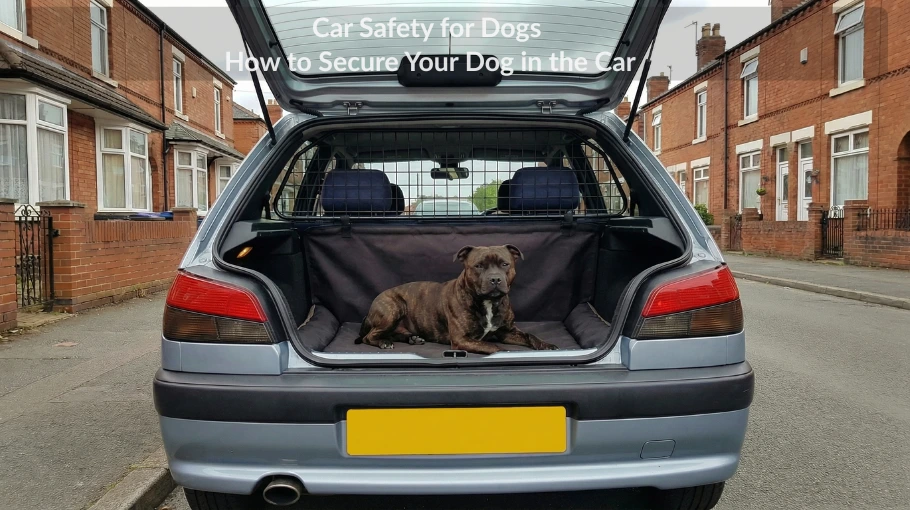
Seeing dogs with their heads out the car window looks cute, but with strong, high-energy dogs, it isn’t always safe. Ours are curious enough that I couldn’t trust them not to jump.
Keeping excitable dogs contained brings a few extra challenges — especially for dogs that are muscular, reactive, or easily overstimulated by what they see outside.
And it’s not just about comfort. In the UK, the Highway Code requires dogs to be “suitably restrained” so they can’t distract the driver or get hurt if you brake suddenly. That still leaves room to choose a setup that keeps your dog secure and the journey calm for everyone in the car.
How to Secure Your Dog in the Car
Back-Seat Setups for Safe Dog Travel
If your dog travels in the back seat, the aim is to create a defined, comfortable space where they can sit or lie down without slipping, climbing forward, or shifting their weight into unsafe positions.
For calmer dogs or short, routine trips, back-seat setups can work well — but some designs are more suited to energetic or muscular breeds than others.
Seat Covers and Hammock-Style Setups
A simple seat cover protects your upholstery, but a hammock-style cover adds a gentle barrier by spanning between the front and back seats. They help to:
- prevent sliding on leather or fabric
- stop dogs falling into the footwell
- create a semi-enclosed space that encourages them to stay put
Hammocks aren’t restraint systems on their own, but they act as a physical cue. For many dogs, that’s enough to keep them settled on shorter journeys.
However, the designs vary:
- Shorter hammocks leave a gap between the two front seats. Determined dogs — especially strong, enthusiastic breeds — will still try to push through.
- Full-height or full-width versions close off that centre gap almost entirely, leaving only the side windows for viewing.
- Mesh-front hammocks allow airflow and visibility while blocking forward movement. These work for gentle nudges but not for dogs who would head-butt their way through a weak panel.
Hammocks are great for comfort, cleanliness, and gentle boundaries. They’re not ideal for dogs who test limits or try to get to the front whenever something outside catches their eye.
Soft Back-Seat Barriers
Soft barriers fit between the two front seats to block the centre gap. They’re designed to stop casual attempts to climb forward, not serious lunges.
There are a few styles:
- Low barriers that attach to the sides of the front seats but leave upper gaps
- Full-height barriers that reach from the seat bases to the roof lining
- Mesh-panel barriers that let the dog see through but prevent access
- Hybrid protectors that combine a hammock, seat protector, and barrier into one unit.
Full-height barriers reduce nearly all forward access, while mesh versions allow visibility without letting the dog slip through.
Seatbelt Restraint Options for Dogs
There are two main ways to secure a dog using the car’s seatbelt: a short seatbelt attachment that clips to their harness, or a crash-tested car harness that the seatbelt threads through. Both limit forward movement, but they work differently and suit different kinds of dogs.
1) The Seatbelt Attachment (Most Common Setup)
This is the setup most people picture.
A short tether loops around the car’s seatbelt, the seatbelt clicks in as normal, and the clip on the tether fastens to your dog’s harness. In practice, it creates a diagonal safety line across the back seat. Your dog can move a little from side to side, but they can’t get into the front.
It’s simple, quick to use, and ideal for:
- short trips
- dogs who travel calmly
- younger dogs still getting used to the car
One of mine struggled with travel sickness as a pup, so the ability to unclip the tether quickly and get him outside made journeys much easier. No crate doors, no struggling to clip the lead with an open boot and a free-to-jump Staffy — just unclip, attach the lead, and out he went.
Where this setup becomes limiting is in comfort.
As dogs fill out — especially muscular breeds who prefer to lie down — the short length of the attachment can make them feel restricted.
Ours eventually grew frustrated because they couldn’t stretch out on longer drives. The whining and restlessness were a clear sign they’d outgrown the setup.
On longer journeys, that’s when we accepted that the boot would be their long-term space.
2) Crash-Tested Car Harnesses (Less Common, More Structured)
These harnesses work differently. Instead of attaching a tether, the car’s seatbelt passes through the harness. They’re designed to hold the dog in a fixed position and spread force safely in an impact.
They’re sturdier and more controlled, but they also:
- limit movement almost completely
- require a dog who’s happy staying upright
- may feel too restrictive for dogs who like to settle by lying down
Because of this, they suit some dogs very well but aren’t ideal for every temperament or build.
Which One Makes Sense?
For many dogs, the tether-and-harness setup is perfectly fine during puppyhood and for shorter trips. As dogs mature, gain muscle, and want more freedom to lie down, those back-seat restraint systems no longer keep everyone comfortable — which is often the point where moving the dog to the boot with a barrier or crate becomes the better option.
Boot Crates and Boot Containment Systems
For dogs who travel best with clear boundaries, the boot can be the safest and calmest place. Whether you use a crate or a structured divider, the goal is the same: give your dog a defined space where they can settle, lie down, and ride without affecting the driver or other passengers.
Boot setups are particularly helpful for dogs who shift their weight or turn frequently, and for many Staffies a secure boot travel setup offers the safest and most predictable ride.
Why Boot Crates Improve Safety
A crate or enclosed boot space keeps the dog in one predictable area, which prevents:
- climbing into the rest of the car
- sliding during braking
- sudden lunges toward windows
- pacing or shifting their weight in unsafe ways
For dogs who get overstimulated by passing scenery, the enclosed feel often helps them settle and relax.
Types of Boot Containment Setups
Boot spaces can be configured in a few different ways depending on how many dogs you have, their temperaments, and how much structure they need.
1) Single Crate in the Boot
The simplest setup: one appropriately sized crate placed in the boot, with the door facing outwards. It gives the dog a secure, den-like space where they can stand, turn, and lie down without roaming.
Ideal for:
- one dog
- dogs who settle well in enclosed spaces
- owners who want the most controlled environment
A stable, well-fitting crate prevents sliding on corners and keeps the dog safely contained.
2) Boot Divider Creating Two Compartments
Some vehicles allow a metal divider to be fitted in the boot. This splits the space into two sections — handy for separating dogs, managing different sizes or temperaments, or simply keeping things calmer.
We once travelled back from a country walk with friends who used this setup. Their older Staffy stayed in one compartment, and the younger pair were on the other side. With only the youngsters that day, our two hopped into the other compartment — four dogs total — and it stayed surprisingly calm thanks to the clear boundaries.
Even without individual crate doors, the divider (plus a barrier behind the back seats) kept everything secure.
3) Two Crates Side by Side
Common with dog walkers and working-dog owners.
This creates completely separate, predictable spaces and works well when dogs:
- need their own space
- travel frequently
- settle better in enclosed areas
- differ in age or temperament
It does take more room, but it’s one of the most structured and reliable setups.
Boot Barriers — When You’re Not Using a Crate
Unlike boot dividers, which split the boot into two separate compartments, a boot barrier simply creates one safe, contained area across the whole boot. These are solid panels or metal guards that fit behind the back seats to stop the dog moving into the rest of the car.
Boot barriers are a practical middle ground for dogs who need space to stretch out, for cars where a crate won’t fit, or for owners who want the boot to remain fully usable without installing a full crate system.
When Boot Barriers Make Sense
Boot barriers are especially useful when:
- your dog prefers lying down rather than sitting upright
- your car is too small for a crate (common with hatchbacks)
- you need the entire boot space for one or two dogs
- you want dogs safely contained without giving up the back seats
- your dog gets frustrated by the restricted movement of back-seat tethers
- you want a setup that installs easily and removes quickly
In our smaller hatchback, fitting a crate would mean folding the back seats down — not practical for everyday use. Instead, we raise the three rear headrests to act as a boundary, and use a quilt with a washable cover as their boot “bed.”
It’s comfortable, easy to clean after muddy walks, and the dogs have enough space to lie down without trying to push through into the back seats.
How Boot Barriers Keep Dogs Secure
A proper boot barrier:
- stops dogs climbing over the seats
- keeps them from wandering forward during braking
- prevents excitable lunges when something catches their eye
- protects passengers from sudden weight shifts
- creates a predictable area where the dog can settle themselves
This is especially helpful for dogs who get overstimulated by passing cyclists, livestock, or scenery — all things you can’t always predict. Containment gives the dog space, but keeps excitement where it belongs: behind the barrier.
Types of Boot Barriers
Boot barriers vary widely in design:
1) Headrest-Mounted Barriers
These attach to the metal bars of the rear headrests and form a panel across the back seats.
Good for:
- hatchbacks and smaller cars
- dogs who don’t push heavily against boundaries
- lightweight setups that are easy to remove
2) Floor-to-Ceiling Barriers
These clamp into place from the car floor up to the roof lining.
Best for:
- stronger, determined dogs
- larger breeds
- owners who want maximum security
These offer far fewer gaps and are harder for a dog to push past.
3) Integrated Car-Specific Barriers
Some cars have optional, model-specific barriers that fit the vehicle perfectly. They’re sturdy, rattle-free, and reliable, making them ideal for dogs who move around a lot.
Making the Boot Comfortable for Your Dog
Boot spaces are often more relaxing for dogs because they can:
- lie down naturally
- shift position freely
- avoid being overstimulated by front-seat activity
- settle into a routine more easily
A soft quilt, blanket, or washable dog bed gives them grip, comfort, and cushioning on corners.
For larger dogs or two medium-sized dogs, a barrier setup provides space without compromising safety.
Why Containment Matters More Than Many Owners Expect
Most people think about car safety in terms of preventing a dog from climbing forward — but behaviour on the road can be unpredictable. Dogs react to things we don’t always anticipate.
Even well-travelled dogs can react unexpectedly. Mine have had their moments over the years: the first time they saw horses up close, a sudden spinning windmill, even recognising the familiar route to the vet.
One of them once became so overwhelmed by the sight of horses that he jumped around the boot barking and darting side-to-side. If the rear headrests hadn’t been raised to block that gap, he’d have been straight into the back seats in a frenzy.
Moments like that are exactly why choosing the right setup matters — dogs don’t always behave the same way every journey. What works during a calm five-minute trip might fall apart the moment something unexpected appears outside the window.
The safest arrangement is always the one that suits both your dog’s temperament and the layout of your car — not just the equipment you happen to own.
How to Choose the Best Setup for Your Dog and Your Car
There isn’t a single “right” setup for every dog. It depends on your dog’s behaviour and your car’s layout.
Match the Setup to Your Dog’s Behaviour
- Calm, predictable dogs:
Back-seat hammocks or simple seatbelt restraint setups usually work fine. - Easily stimulated or reactive dogs:
Crates or solid boot barriers reduce visual triggers and prevent sudden lunges. - Dogs who dislike restriction:
Boot setups with a barrier give them space to lie down and shift position. - Dogs who get anxious watching traffic:
A crate or a more enclosed boot area helps create a quieter, den-like space. - Multi-dog households:
Boot dividers or side-by-side crate setups stop crowding and keep the journey calmer.
Match the Setup to Your Car Layout
- Hatchbacks and estates:
Boot crates or barriers work well because the boot is accessible and roomy. - Smaller hatchbacks:
Crates often don’t fit without folding seats; barriers or raised headrests can be the practical choice. - Low boot heights:
Dogs may not be able to stand comfortably, so back-seat travel may be better. - Tall SUV boots:
Larger gaps above the back seats may require a stronger barrier to prevent climbing.
A simple example from our own setup: in our smaller hatchback, raising the rear headrests and giving the dogs a quilted boot bed works better than trying to squeeze in a crate. It gives them space to lie down and keeps the back seats usable.
Questions to Ask Yourself
- Does my dog settle or do they pace?
- Are they easily triggered by things outside?
- Do I need something quick to install and remove?
- How much boot space do I realistically have?
- Do I carry passengers in the back seat?
- Does my dog prefer lying down or sitting upright?
- Am I transporting one dog or several?
Choosing the Right Setup
The best arrangement is the one that keeps your dog secure and lets them travel comfortably. Once you match temperament to vehicle layout, the safest option usually becomes clear.
Final Thoughts
Driving with a dog loose in the car isn’t just unsafe — it creates stress for everyone on board. Strong, energetic dogs in particular benefit from clear boundaries and a setup that helps them relax rather than patrol the car.
Whether your dog travels in the back seat or the boot, the aim is the same:
a predictable, secure space where they can settle and you can focus fully on the road.
Once you choose an arrangement that suits both your dog’s temperament and your car’s layout, the difference is immediate. Journeys feel calmer, safer, and far more enjoyable — for you, your passengers, and your dog.
FAQs
Why does my dog suddenly become reactive in the car?
Dogs can react to unexpected sights, sounds or movement outside — livestock, cyclists, dogs, sudden landmarks, or even recognising the route. These reactions can happen without warning, even in dogs who are normally calm. A secure setup prevents these split-second moments from becoming a safety issue.
What are the rules about dogs travelling in cars?
The Highway Code requires dogs to be “suitably restrained” so they cannot distract the driver or be injured if you brake suddenly. It doesn’t mandate a specific product — only that the dog must not move freely around the car.
Are dogs allowed in the front seat?
Yes, but it’s discouraged. Airbags can injure dogs, and the front of the car is the most distracting place for them to sit. If your car allows the passenger airbag to be switched off, that’s advised, and the seat should be slid as far back as possible. The dog must still be properly restrained.
Is a dog lying in the boot “securely contained”?
Yes, as long as they cannot climb into the cabin. In hatchbacks and SUVs, a boot barrier or crate is usually needed to make the space secure. A loose dog that can jump over the seats or move between areas would not be considered suitably restrained.
I can’t fit a dog crate in the boot of my car — what can I use instead?
Many hatchbacks don’t have crate-friendly dimensions. In these cases, a solid boot barrier (or raised headrests in smaller cars) combined with a comfortable, non-slip surface gives your dog space to lie down while keeping them safely contained.
Do I need a boot barrier if my dog has never tried to climb over the seats?
Yes. The risk isn’t day-to-day behaviour — it’s sudden reactions to things outside. Even calm dogs can lunge forward unexpectedly. A barrier prevents a moment of surprise turning into a hazard for you and your passengers.