
5 Proven Steps to Teach a Dog to Relax in a Crate
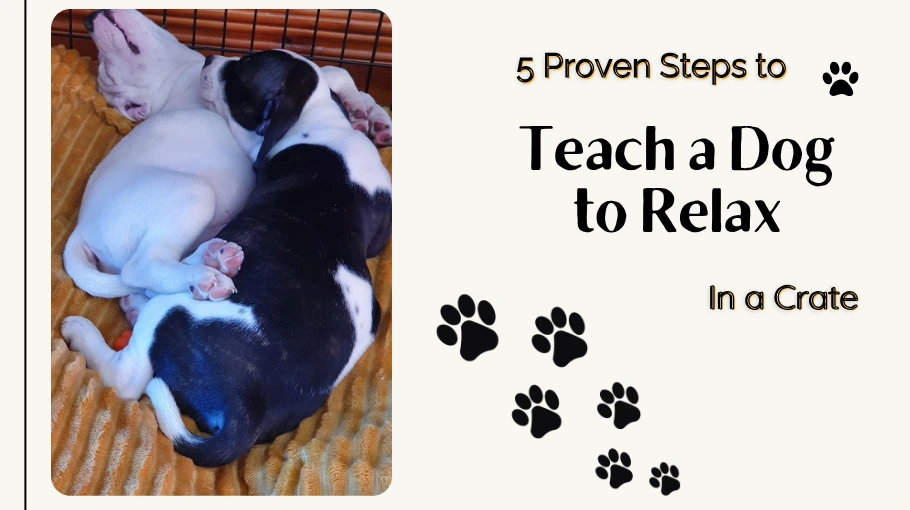
Crates keep dogs contained but they don’t have to be a holding pen. For dogs that whine, bark, howl, pace, and even try to escape, what you need isn’t just a way to contain your dog, but a way to teach a dog to relax when you’re not around.
That way, you can go about your day confident that your dog is safe, your furniture is intact, and your neighbours aren’t driven crazy by a stressed-out pup.
Teach Your Dog to Relax in 5 Progressive Steps
1. Set the Environment Right
Some dogs are easily excitable. To have a chance at getting them to chill, remove the stimulation. That’s easier done with a cover over the crate because it instantly creates a low stimulation environment.
That said, the best position for the crate depends on your dogs nature. Ours, for example, love to know what’s going on. It’s their home so they don’t get put into another room when people visit. They do get told to go to “bed”.
Now, we have the crate in the living room facing toward us. The crate has a cover on it, and with that down, the visual stimuli is gone. For nervous and highly excitable dogs, the best location might be in another room away from all stimuli, visual and audio.
To encourage relaxation, sometimes it’s more about what’s in the crate that makes the biggest difference. If you’re unsure about what to put in a dog crate, there’s 3 things I’d suggest – familiar scents, something for chewing, and obviously, a comfy bed that they’ll want to lay down on. The more comfortable it is for the dog in the crate, the more likely it is they’ll relax.
2. Build Positive Associations
When they go in voluntarily, praise them. When they settle with the door open, slowly and quietly close the door. Expect them to get up and have a treat ready to give. Praise as they get the treat, then walk away.
For dogs with severe crate aversion, like, they will not go in it, encourage them by feeding them inside the crate. Not as a form of bait where you put the food in then close them in the crate when they go for food. Leave the door open and just let them get used to going in and out freely.
There’s also chews and enrichment tools like Kongs and licki-mats. As you’re getting them used to being in the crate, use these tools while you’re there because anxious dogs in a crate can chew destructively so any new toys and chews should be supervised to see how they interact with it. A lot of chews and toys aren’t suitable for unsupervised use. Be careful with what the dog has access to.
Also, for those who have never tried a crate for a dog, instead, sticking to a bed or a mat, I’d suggest reading through Crate Training Benefits and How to Do It, because I found the hardest part being not caving in to feelings of guilt. Seeing them confined to a crate, not able to interact, or be petted for reassurance, can make you instinctively feel it’s time to let them loose.
Stick it out!
At the very least, have them do a basic command like sit and wait so they can wander out the crate calmly, rather than bolt as soon as the door is opened. Because, when you feel ready to let them out the crate when guests are around, you can’t have them bolting, and jumping.
Which brings me to the next point…
3. Make It a Daily, Low-Stress Habit
Know this: your dog likely won’t settle right away. Those calm signals you want, won’t happen quickly. Like lying down quietly, sighing, or calmly chewing a toy.
At first, you’re more likely to see stress signals… the whining, pacing, panting, or even ignoring treats. That’s normal.
It’s a transitional phase, and it’s one that takes consistency for your dog to progress to being calm in the crate.
To help them reach that stage, make crate time a daily habit. Start with just a minute or two to build up their tolerance. The best time is when you get alone time with them.
Remember the first step – low stimulation environment? When the house is quiet, turn the TV off, help them settle outside the crate, then encourage them into the crate and get them used to it. Once in, leave them be and watch their body language.
Each of these are calm signals to reward:
- Lying down calmly, especially on their side or curled up.
- Sighing or taking deep, slow breaths.
- Chewing calmly on a toy or treat
- Ears in a relaxed position, eyes soft or slowly blinking
When you see that happening, praise the behaviour, not excitedly, but just engaging with a soft-spoken ‘attaboy.
If the dog shows signs of stress in the crate, which are these:
- Whining, barking, or howling.
- Excessive panting (without being hot).
- Pacing inside the crate or trying to escape.
- Lip licking, yawning (as a stress signal), or drooling.
- Trembling or tense body posture.
- Ignoring high-value treats or toys.
Don’t call it quits early. Cast your mind back to your puppy training days to recall what you did to calm them down. For us, we learned a few tricks for how to calm a Staffy pup down – music, petting, and given them alone time.
Help them relax outside the crate, then when their calm, have them go into the crate. Even just a few minutes to start with, then gradually build up the duration as your dog begins to feel safe and relaxed inside.
4. Use Tools That Support Calm
Of all the dog training tools and equipment available, the best for relaxing a dog are things that remove stimuli. Covering the crate with a cover, playing soothing music for dogs with anxiety, natural chews, familiar scents, or even dog calming bed sprays that have aromas of chamomile or lavender to help them relax.
If you’re dealing with any of the many types of dog anxiety, you’ll likely need to be more involved, meaning, the strategy of crating the dog with a comfy bed, a chew and some white noise, won’t be the best approach. For example, to ease separation anxiety in dogs, the first step is gradual independence training. Getting the dog used to alone time.
5: Set the Stage with Physical and Mental Exercise
If there’s one thing to remember, it’s this… A tired dog is a relaxed dog. And there’s more than one way to tire a dog, and surprisingly, mental stimulation is more exhausting than a sprint in a park.
The simplest way to teach a dog to relax in a crate is to associate the crate with tiredness. A haven to relax in with limited things calling for the dogs attention. Somewhere it can go to chill without fighting sleep, like trying to keep one eye open to watch the goings-on in the room.
Before giving the command for the dog to go to the crate, set it up for success. Do a short obedience session before crate time. Use treat-dispensing puzzles, or scatter some tasty treats when the dog’s not in the room – a quick round of “find it” can settle them faster than 20-minute jog.
When the crate follows activity, it becomes the natural place to decompress. It’s not just a spot they’re told to go. For those of you with high energy dogs like Staffies, there’s some simple ways to handle hyperactive dogs that will have them strutting into their crate, glad for the retreat. Brain training games being one of the most effective.
Use whatever tools resonate best with your dog – soothing sounds or calming scents or chews, and have the dog engage mentally before going to the crate. In essence, the crate becomes a reward, where the dog can get rest in its safe space.
In Conclusion:
The best way to teach a dog to relax is to begin by encouraging calmness outside the crate, progressing to inside the crate. Remove stimuli, build positive associations (not using the crate as punishment), and consistently encouraging the dog to go into the crate voluntarily, using whatever tools help your dog relax – scents, sounds, or something to chew inside the crate. And gradually increase the time from a couple of minutes up to a 10 to 15 minute snooze session.
If after following those steps, you still feel like you’re hitting a wall, it might be worth considering if the crate is the issue. Particularly for nervous dogs, for which there are specialty types. Some of the best dog crates for anxiety focus on removing stimuli while addressing the behavioural issues.
What’s helped your dog learn to relax, either in the crate or just in general? I’d love to hear what’s worked for you. Comment below ↓↓↓↓