
What To Put In A Dog Crate (For Comfort, Safety, and Calm)
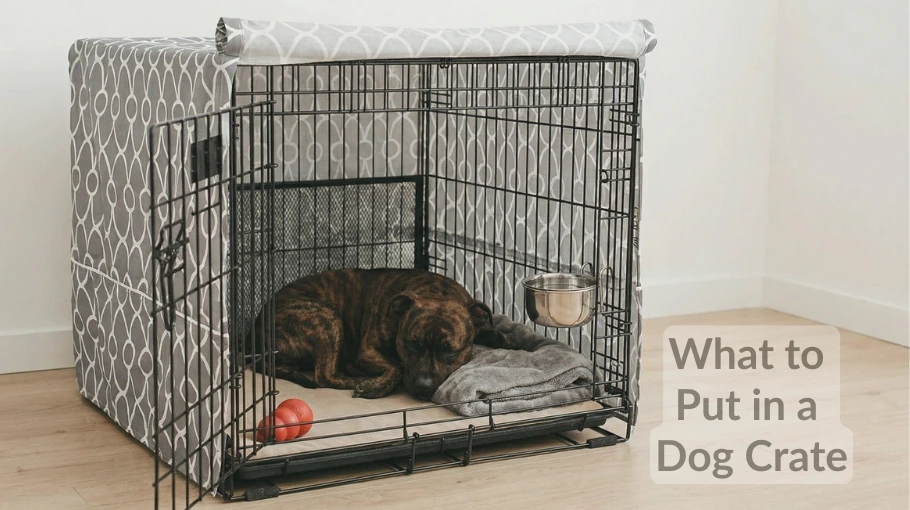
There’s no hard-and-fast rule for what goes in a dog crate.
Because what works changes with age.
Some things that suit puppies stop being appropriate as they mature.
Other items feel helpful at first, but end up getting in the way.
The purpose of a crate setup is to encourage calm, not entertainment —
and to remove anything that compromises safety.
Discover What Does and Does Not Go in a Dog Crate (and Why)
The Absolute Essentials (Non-Negotiables)
When it comes to crate setup, more isn’t better.
A dog crate works best when it’s simple, predictable, and safe.
Overfilling it often creates risks people don’t realise until something goes wrong.
There are essentials to think about first.
Bed or Base Layer (Not Always a Bed)
Every crate needs something for your dog to lie on.
That doesn’t automatically mean a plush bed.
When ours were pups, we skipped foam beds entirely and used a fleece throw instead.
Threads can come loose — but there are no chunks of foam to bite off or swallow.
That felt like the safer option for us during the chewing phase.
As dogs mature, some settle well on proper crate beds or mats.
Others continue to dig, nest, or chew — and for those dogs, simpler is still safer.
If your dog chews bedding at all, a towel or folded blanket is often the lowest-risk option.
Fewer Items = Fewer Accidents
This is especially important with wire crates.
Gaps along the lower sides can catch paws or claws when dogs shift position or stretch —
particularly around the lower part of the door.
What we did was line the lower section with folded towels or throws.
Used properly, they act as soft bumpers and help block those gaps.
For extra security, threading them through the crate bars keeps them in place and reduces movement.
That lowers the chance of a leg slipping through.
There are also purpose-made crate bumpers designed to do the same job —
something we didn’t know about at the time, but would have considered.
Safe Enrichment (Not “Toys” as a Catch-All)
We don’t leave our dogs in crates with toys when we’re out.
That’s a personal risk decision — not a universal rule.
There’s no such thing as a truly indestructible dog toy.
Even tough nylon chews wear down over time — not by snapping, but through gradual grinding and abrasion.
When small pieces start to shed, the toy goes in the bin.
For unsupervised crate time, the only enrichment we’d consider is something that:
- wears down very slowly
- is used only in the crate
- isn’t already weakened by daily play
A brand-new nylon chew, or one reserved purely for crate use, fits that criteria best.
When our two were pups, this was something I spent a lot of time researching.
Advice about “safe enrichment” for unsupervised crate time comes up again and again.
What’s often missing is an important distinction.
There are lower-risk options — but there are no zero-risk ones.
That difference matters when no one is there to intervene.
Why Keeping It Simple Matters
Every extra item increases:
- the chance of chewing
- the chance of breakage
- the chance something goes unnoticed
A calm crate isn’t built with entertainment —
it’s built with predictability and rest.
Once those are solid, enrichment becomes optional, not essential.
Bedding: What to Use, What to Avoid, and Why
Crate bedding isn’t about luxury.
It’s about cleanability, durability, and safety —
especially when dogs are wet, muddy, or still learning boundaries.
What works in a crate isn’t always what works elsewhere in the house.
What’s Worked Best for Us: Crate Mats, Not Plush Beds
The setup that’s lasted longest for us is a waterproof crate mat.
Ours is a sofa-style frame with a fitted padded cushion inside.
The whole thing can be wiped down or hosed off if needed.
That matters after wet walks.
If the dogs come back soaked, they go straight into the crate to settle and dry off.
Fabric beds would be a pain here — this setup isn’t.
The brand we originally bought from no longer exists.
The closest equivalent is a faux-leather style dog sofa with a removable cushion sized to the crate’s internal dimensions.
Over time, that ease of cleaning has mattered more than softness.
If something can’t be cleaned quickly, it tends to become a problem rather than a comfort.
Before they were trusted with cushioned beds outside the crate, those beds were earned slowly.
At first, they were only allowed them when we were in the room.
If licking or gentle nibbling started, it was met with a quiet “uh-uh” — a clear signal that the bed wasn’t something to chew.
It wasn’t about taking the bed away every time.
It was about setting the expectation.
They weren’t allowed cushioned beds overnight either.
For sleeping, they went back to the crate and the more durable setup.
A few beds were destroyed along the way — that was part of the process.
We deliberately started with cheap, budget padded beds, knowing some wouldn’t last.
When one was chewed through, it simply meant a return to crate sleeping for a night or two.
After repeating that cycle a few times, the padded beds started lasting longer.
Not because the beds were better — but because the behaviour had changed.
“Indestructible” Bedding Isn’t Always Indestructible
We’ve tried Vetbed in the past.
It has a reputation for being almost chew-proof —
and it didn’t last an afternoon.
That was years ago, with our first Staffy pup, Tizer (nicknamed Chunk).
Back then, the crate setup was basic and uncovered.
The environment mattered more than we realised.
With our dogs now, we took a different approach:
- calmer crate location
- cover down
- background noise to soften sudden sounds
Same breed.
Different setup.
Very different results.
Bedding by Age and Life Stage
Puppies
- Towels or folded throws until toilet training is solid
- Cheap, replaceable layers
- Nothing with foam that can be pulled apart
Young Dogs
- Budget mats or beds while chewing is still a risk
- Expect some losses — it’s part of the process.
We did have a couple of “no-bed nights” after chewing incidents.
Not as punishment — just natural consequence.
Beds destroyed → beds removed.
They learned quickly.
Adult Dogs
- Waterproof mats in the crate
- More comfortable beds elsewhere in the house
Our dogs sleep on warmer, fabric beds with bolster edges upstairs.
Those are for nighttime comfort — not crate use.
Over time, we’ve found that certain types of beds work better in crates than others — and which ones make sense depends entirely on the stage your dog is at.
Orthopedic Beds: When (and When Not) to Bother
We didn’t invest in orthopedic beds early on.
There was no need.
The better guide isn’t age.
It’s what you see.
If walks start looking stiff, slower, or uncomfortable,
that’s when extra support makes sense.
The Big Bedding Takeaway
Crate bedding should be:
- easy to clean
- hard to destroy
- boring enough to sleep on
Comfort matters — but context matters more.
A calm crate environment often does more than upgrading the bed ever will.
Water in the Crate: Yes, No, and When
Water inside a crate isn’t a rule — it’s a judgement call.
Whether it helps or hinders depends on duration, environment, and the dog.
Should You Put Water in a Dog Crate?
This gets debated a lot.
And like most things in dog care, the real answer is: it depends.
If your dog is only crated for short periods — an hour or two —
they usually don’t need water in the crate.
In some cases, leaving a bowl in there causes more problems:
- spills
- soaked bedding
- stress drinking
For longer crate periods, warmer weather, or medical reasons,
access to water does matter.
What matters just as much is how that water is provided.
Depending on your setup, some dogs will dig at a floor bowl rather than drink from it —
which usually ends in a mess, not hydration.
Considering a healthy dog needs roughly 40–60 ml of water per kg of body weight per day, you almost certainly don’t need a loose bowl sitting on the crate floor.
A no-spill water bowl that can’t be pawed at, tipped, or dragged around is usually the cleaner, calmer option — especially for dogs that dig at water instead of drinking it.
When Water Can Be Skipped
- Overnight sleeping
- Short rest periods
If you’re unsure whether your dog actually needs water in the crate, there are simple ways to check hydration levels before it becomes an issue.
Safe Things to Leave in a Dog Crate
This is where opinions differ — and for good reason.
What’s “safe” depends on:
- the dog
- the item
- how long they’ll be alone
- and whether anyone is there to intervene
For us, crate safety always comes down to one question:
If this breaks, what happens next?
Crate-Safe Enrichment (With Limits)
When ours were very young — right in the teething phase —
they had a small face-cloth style comfort item from the breeder.
It smelled like the litter and acted like a soother.
More comfort than toy.
We used to chill it briefly in the fridge — not freeze it —
just enough to cool sore gums, not encourage chewing.
That stage didn’t last long.
As they got older, enrichment became situational.
- Short crate periods → a newer nylon chew
- Several hours alone → nothing
The aim wasn’t to take away fun or make the crate boring.
It was simply about managing risk when no one was there to step in.
If a dog is whining or unsettled in the crate, it’s natural to feel like something needs to go in there to keep them busy.
Sometimes that means choosing chews that actually hold up under supervision.
Other times, it’s about teaching dogs how to settle, rather than trying to distract them.
If you’re weighing up both sides, these may help:
- Durable dog toys for aggressive chewers (for supervised use)
- How to calm a Staffy pup down (quiet-time crate training when you’re present)
Soft Toys: When They’re OK (and When They’re Not)
Some dogs soothe with soft toys.
Others dismantle them methodically.
Stuffless toys remove one risk — loose filling —
but not all risks.
If your dog:
- shreds fabric
- pulls seams apart
- or eats what they tear off
Soft toys don’t belong in an unsupervised crate.
It’s not about the toy.
It’s about the dog in front of you.
Items to Avoid Completely in Crates
Some things just don’t belong in crates at all.
- Squeaky toys (encourage arousal, not calm)
- Rope toys (especially once strands loosen)
- Household items like socks or clothing
This is where safety thinking changes once you’ve seen enough.
When dogs ingest small amounts of toy material repeatedly,
it doesn’t always show up immediately.
From experience, that’s changed how we assess risk.
Long fibres, rubber fragments, or tough materials
aren’t designed to pass through a dog’s system safely.
If there’s a realistic chance something could:
- lodge
- tangle
- or require intervention
it doesn’t go in the crate.
Nylon Chews: New vs Worn
We keep two categories of nylon toys:
- crate-only, newer chews
- well-worn playtime chews
Once a nylon toy starts shedding pieces, it’s done.
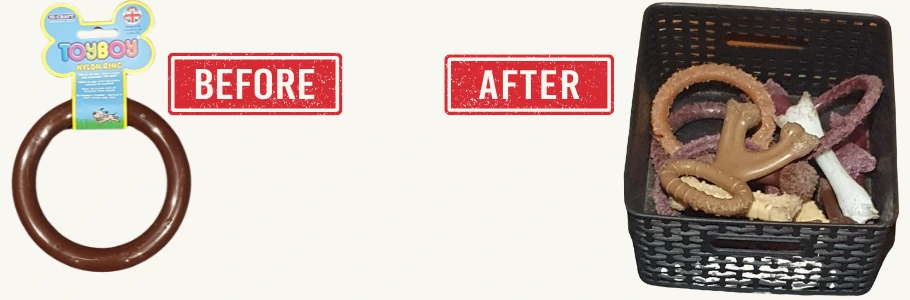
Some people believe rough, worn surfaces may help scrape plaque.
That may or may not be true.
What is true is that loose fragments create a choking risk.
That’s the line.
Problem-Solving Dogs and Crate Safety
Many dogs are more capable problem-solvers than they’re given credit for.
If there’s a weakness in a toy or setup,
some dogs will find it through persistence alone.
That doesn’t make them destructive —
it means they’re good at working things out.
Crate safety isn’t about tougher equipment.
It’s about reducing variables.
Common Mistakes That Make Crates Unsafe
Crates don’t usually become unsafe because of one big mistake.
They become unsafe through small, well-intended decisions that add up.
Too Many Items
It’s tempting to make a crate feel cosy by filling it.
Beds, toys, bowls, chews — all in one space.
The problem is that every extra item:
- increases movement
- creates friction
- adds something that can be chewed, tipped, or tangled
A calm crate works best when it’s simple.
New, Untested Toys
This is one of the most common mistakes.
Just because a toy is labelled tough or indestructible
doesn’t mean it’s safe for unsupervised use.
We learned this with very hard chews.
Things like:
- antlers
- buffalo horns
- large bone-style chews
Our dogs loved them.
But what we noticed wasn’t about the toy breaking —
it was about the impact on teeth and gums.
With our senior, a so-called “indestructible” ball held up perfectly.
His mouth didn’t.
After a session of aggressive chewing, his gums were bleeding,
and his bite strength was never quite the same afterward.
With our pups, buffalo horns caused a similar reaction.
That’s when we limited them to short, supervised sessions only.
Anything so tough that you have to time-limit its use
doesn’t belong in a crate.
If you haven’t watched how your dog interacts with a toy,
it doesn’t go in the crate.
Food Bowls Left Unattended
Loose food bowls cause more issues than they solve.
They get:
- tipped
- dragged
- pawed at
And in a confined space, that quickly turns into mess or frustration.
If food or water is needed in a crate,
it should be secured and appropriate for that setting.
Collars or Harnesses Inside Crates
This one often gets overlooked.
Collars and harnesses can catch on:
- crate bars
- bedding
- toys
For crate time, dogs are safer without anything attached.
Crates should be places to rest, not gear up.
Let Your Dog’s Behaviour Guide Your Decisions
Some dogs carry items gently, almost like comforters.
Others go straight into problem-solving and destruction mode.
Neither is wrong.
But crate safety depends on knowing which dog you have,
and setting the crate up accordingly.
Ultimately, What Goes in a Dog Crate Should Make It Feel Comfortable and Calm
A crate doesn’t need to be entertaining.
It needs to feel predictable.
For most dogs, calm comes from:
- fewer items, not more
- familiar smells, not novelty
- an environment that limits stimulation
That’s why things like crate covers, simple bedding, and consistent setups often matter more than toys.
If a dog feels safe and settled, they rest.
If they’re overstimulated, they look for something to do.
That’s when chewing, digging, or frustration starts.
When in doubt, strip the crate back to basics and build up slowly.
Watch how your dog responds — not what the packaging claims.
The right setup isn’t about what should work.
It’s about what actually does.