
How to Choose the Right Dog Crate (Staffy-Focused Buyer’s Guide)
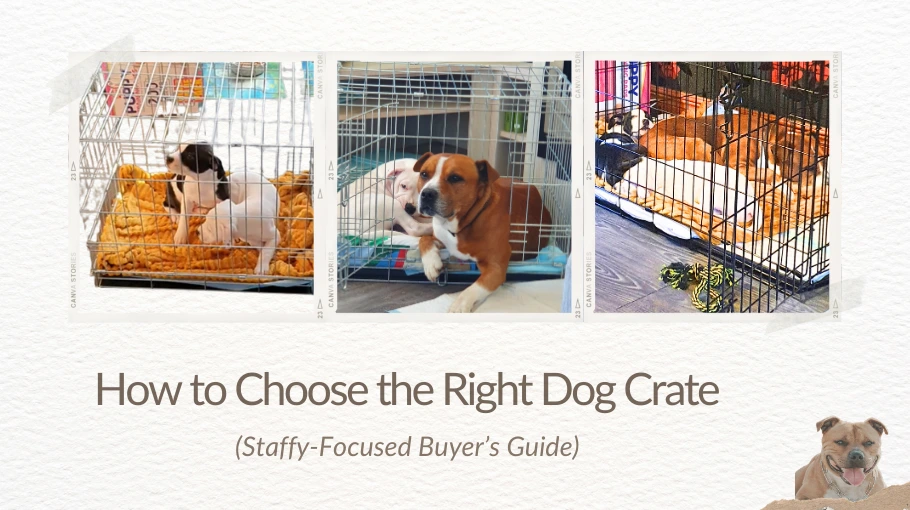
Sizing charts are illustrative, but they don’t do much to help you pick the right crate for a Staffy. They’re technically a medium-sized breed, yet most Staffies need a size bigger than the “medium” category suggests. Throw a Staffy cross into the mix and you’re dealing with a whole range of dimensions.
A 30-inch crate is generally the minimum for most adult Staffies. Whatever you choose, the important thing is that your dog can stand, turn, lie down, stretch and — most importantly — feel secure and comfortable.
And you should feel secure and comfortable leaving them in it too. That means no wire bars with gaps big enough for paws to slip through, a sturdy build, and plenty of ventilation to stop them overheating.
One thing worth saying early: don’t let tiny puppy teeth fool you. We’ve had a Staffy pup chew straight through a wooden skirting board, and the breeder later sent us photos of two littermates who shredded an entire sofa. Staffy pups explore with their mouths, and they’re determined when they set their mind to something.
The first few days of crate training aren’t easy either. The whining tugs at you and makes you want to cave in. Don’t. It’s not cruel to crate dogs — not when you make it a comfort zone and not a “sin bin,” as the RSPCA puts it in their crate guidance.
The aim is simple: secure, safe, comfortable. Keep those three words in mind and everything else becomes easier to decide:
- which crate type suits your dog’s behaviour
- which size offers enough room without making them feel exposed
- how much enclosure or visibility they settle best with
- how to choose between wire, soft, plastic, travel or furniture-style crates
- and whether to use a divider for a puppy growing into their adult size
As you read on, all of these will become clearer, and you’ll be confident choosing a crate that works for both your dog and your lifestyle — not just today, but for years ahead.
What This Guide Covers
Start With the Purpose of the Crate
Choosing the right crate starts with understanding why you need one. Staffies are incredibly people-oriented and sensitive to routine, so the purpose often dictates not just the crate type, but how enclosed it should be, how much airflow it needs, and how much visibility the dog benefits from.
Owners usually buy crates for one of four reasons:
1. Anxiety & Settling
Many Staffies become overstimulated by noise, movement, or household activity. A crate gives them a predictable “switch-off” space.
- Enclosure helps reduce visual triggers.
- Airflow matters because Staffies run warm, even while resting.
- A smaller, secure-feeling area is often more reassuring than lots of open space.
2. Back-Seat Travel
A back-seat crate or controlled “den” is about comfort and containment, not crash protection.
- Prevents sliding into the footwell.
- Helps reduce reactivity by limiting visual stimulation.
- Needs stable footing and good airflow — Staffies heat up quickly in cars.
3. Secure Boot Transport
Boot crates and transport boxes prioritise safety, structure, and durability.
- Ideal for reactive, strong, or escape-prone Staffies.
- Requires careful car-specific measuring.
- Ventilation and door strength are major factors.
4. Routine, Training & House Management
Crates support:
- Puppy potty training
- Short calm “reset” periods
- Managing overstimulation
- Giving dogs structure during busy times
The Different Crate Types and Materials Explained
When choosing a crate, it helps to understand both the type of crate and the materials it’s built from. Together, these determine airflow, durability, visibility, weight, and how suitable the crate is for Staffies who are strong, curious, and quick to test weak points.
Wire Crates
Wire crates are the most common choice for everyday use.
Pros:
- Excellent airflow
- Easy to pair with partial covers
- Good for routine, training and general home use
Considerations:
- Not fully escape-proof unless reinforced
- Bar spacing and latch design vary between brands
Wire suits most Staffies, provided the crate is sturdy and the dog isn’t a determined chewer or bar-pusher.
Plastic Crates
Plastic crates create a more enclosed, den-like feel.
Pros:
- Reduces visual stimulation for anxious dogs
- Often used for travel
- Lightweight and easy to move
Considerations:
- Retain more heat — important for Staffies
- Not automatically crash-tested (despite appearances)
- Ventilation panels differ widely between models
Best for dogs who settle better with reduced visibility, but not ideal for warm rooms or summer car travel.
Soft-Sided / Fabric Crates
These are portable and comfortable but only for the right kind of dog.
Pros:
- Lightweight and quick to fold
- Great for temporary use, holidays or back-seat comfort setups
Considerations:
- Mesh panels are easily pawed, scratched or pushed out
- Not suitable for chewers, anxious dogs, or escape-prone Staffies
- Least durable option
Use only with well-crate-trained dogs who do not push, chew or paw at the structure.
Heavy-Duty / Aluminium Crates
Built for strength and security.
Pros:
- High durability and escape-resistance
- Ideal for boot transport
- Good airflow depending on cut-out design
Considerations:
- Heavier and generally more expensive
- Bulkier footprint
These are the best option for reactive, strong, or determined Staffies who need a predictable, safe travel setup.
Furniture-Style Crates
Designed to blend into the home rather than offer maximum durability.
Pros:
- Visually appealing
- Doubles as furniture
Considerations:
- Not ideal for strong, enthusiastic dogs
- Ventilation varies
- Wood can swell, warp or be chewed
Best suited to calm adult dogs—not puppies, chewers or dogs who lean heavily on crate sides.
Build Quality & Safety Features to Look For
Regardless of crate type, certain build features make a big difference:
- Strong frame and secure welds
- Reliable door hinges and latches
- Even, safe bar spacing
- A stable base that won’t rattle or slide
- Good ventilation (critical for Staffies)
These details matter more than the crate category itself.
Escape-Resistance Basics
If your Staffy is strong, anxious, or prone to pushing boundaries, look for:
- Reinforced latches
- Strong hinges
- Rigid door frames
- Durable materials that won’t bend under pressure
Wire and heavy-duty crates usually offer the best escape resistance; soft-sided crates offer the least.
Car-Specific Safety
For back-seat or boot travel, it’s worth checking for:
- Anchor points to secure the crate
- Slanted fronts for hatchback clearance
- Recessed or reinforced corners
- Adequate airflow (front + side ventilation)
- Stable, non-slip bases
A crate that shifts or tips during braking can unsettle any dog, especially a Staffy.
How to Choose the Right Size
Size is one of the main factors affecting comfort, behaviour, and safety.
General Staffy Dimensions
Most adult Staffies fall within:
- Height: 35–40 cm at the shoulder
- Length: 60–70 cm (nose to tail base)
- Weight: 12–18 kg (some larger)
Typical Crate Size for a Staffy
Most adults fit best in a 30-inch crate (approx. 76 cm long).
This size gives:
- Enough room to stretch
- A sense of security
- Controlled movement in the car
- No unnecessary “dead space” (which can trigger pacing in anxious dogs)
Some larger Staffies may need the next size up, but 30 inches is the standard starting point.
Measuring Your Dog
- Length: Nose to tail base + 5–10 cm
- Height: Standing top of head or ears + 5–10 cm
Choose the smallest crate that meets these measurements safely.
Puppies: Size for the Adult Dog, Then Use a Divider
You don’t need to buy multiple crates.
- Choose the adult size now (typically 30 inches).
- Use a divider panel to scale the space for a puppy.
Owner Insight: How Our Puppies Learned the Ropes
We were surprised by how quickly our two pups learned the ropes — though I credit a lot of that to our senior Staffy showing them “how life works” at home. We never even needed a divider, but for most puppies it’s a genuinely useful tool that reduces wandering and supports toilet training.
If you’re in that stage now, you may find it helpful to learn more about potty training with a crate.
Why Bigger Isn’t Always Better
Oversized crates can:
- Increase anxiety (too much space feels insecure)
- Make travel less safe
- Encourage pups to toilet in a far corner
Staffies generally relax best in a space that “holds” them slightly, rather than one that feels open or echoey.
Real Example: How Our Staffies Chose Their Space
When we first brought home our two pups, we started with a small metal crate big enough for both of them. Within a week our senior Staffy was trying to squeeze himself in to be with them. We upgraded to two XL wire crates — one per pup — thinking this would give everyone structure.
In reality, they all chose to use the same crate during the day, so we eventually adapted and moved to an open-door setup once the pups were reliable. That experience helped us realise that crate sizing isn’t just about measurements — it’s about behaviour, security, and where the dogs feel most settled.
Ventilation & Heat Management
Staffies overheat faster than many breeds due to their muscular build and tendency to run warm even at rest.
Look for:
- Generous ventilation panels
- Wire or perforated metal designs
- No fully enclosed sides in warm weather
Avoid placing crates:
- Near radiators
- In direct sun
- In cars without active airflow
What Helped Us in Summer
During hot spells we direct a fan toward the crate to keep air circulating — nothing forceful, just enough to stop the air from becoming stale. Others also use cooling mats inside or beside the crate. I did a deep-dive into these and wrote about how to choose the best dog cooling mat, covering things like materials, weight distribution and heat-management pros/cons.
Car Travel: Back Seat vs Boot (and When Each Is Appropriate)
Car travel setups tend to change as your dog grows. When ours were young, we started with seat-belt harnesses in the back seat, but as they filled out it became less practical and we eventually surrendered the boot to them.
Both approaches can work well depending on your dog’s size, confidence and behaviour, so it’s worth understanding the pros and cons of each before choosing the setup that suits your Staffy best.
Back Seat
Best for:
- Anxiety-prone Staffies
- Short journeys
- Dogs who settle better close to the family
These setups rely on containment rather than crash protection.
Boot Transport
Best for:
- Strong dogs
- Reactive dogs
- Long journeys
- Owners wanting predictable structure
Boot crates must be durable, well-ventilated, and properly measured for the car.
Travel Crates vs Transport Boxes
- Transport boxes: More enclosed, reduce visual triggers
- Travel crates: More airflow and structural rigidity
Choice depends on your dog’s behaviour and where they settle best.
Basic Behaviour & Crate Training Notes
A quick mindset note: dogs don’t automatically know how to feel about a crate. Staffies often need time and gentle guidance to understand it’s a safe, predictable place — not a barrier or a trap. The aim is simply to make the crate feel secure and familiar, so your dog chooses to relax there rather than feeling shut away.
If your Staffy is new to crates:
- Pair the crate with positive experiences
- Let them choose to walk in at first
- Keep early sessions short
- Use partial covers if overstimulation is the issue
- Watch for heat build-up
For Staffies who struggle to switch off in general, this step-by-step routine may help: 5 Proven Steps to Teach a Dog to Relax in a Crate
Should You Cover the Crate?
I do cover ours, but there isn’t a one-size-fits-all rule here—it depends on your dog and the environment.
In warmer weather, a cover over a wire crate can restrict airflow, which isn’t ideal for Staffies who already run warm. I’ll often direct a fan towards the crate to keep air moving, but there’s a limit to how much that can help; sometimes you’re just circulating warm air. Cooling mats can offer relief, but in many cases the simplest fix is lifting the cover off entirely to let heat escape.
Where covers really shine is in reducing what your Staffy can see. Less visual stimulation—people moving around, pets passing by, general household activity—often means a calmer dog. During cooler months, or when you need to help them switch off, a cover can create that enclosed, den-like feeling many Staffies settle well in.
The key is to stay flexible: use the cover when it supports calmness, and remove it when temperature and airflow need to come first.
Common Mistakes to Avoid
- Choosing a crate that’s too big
- Using soft crates for chewers or pushy dogs
- Blocking airflow with thick covers
- Not measuring the car boot properly
- Expecting crates to fix separation anxiety
- Placing crates in warm spots
- Ignoring latch and hinge strength
- Treating crates as the only management tool
When setting up your crate, a few essentials help with comfort and safety — I’ve covered them here: What To Put In a Dog Crate.
Where to Go Next
If you have a Staffy, or a breed with a similar muscular build and size proportions, the companion guide narrows the choices.
The Best Dog Crates for Staffies covers three different types.
Wire crates with a cover for the anxious dog, soft carriers for already well-trained dogs (way past the chewing phase), and the boot transport option for safe car trips.