
Soothing Music for Dogs: The Best Calming Options Explained
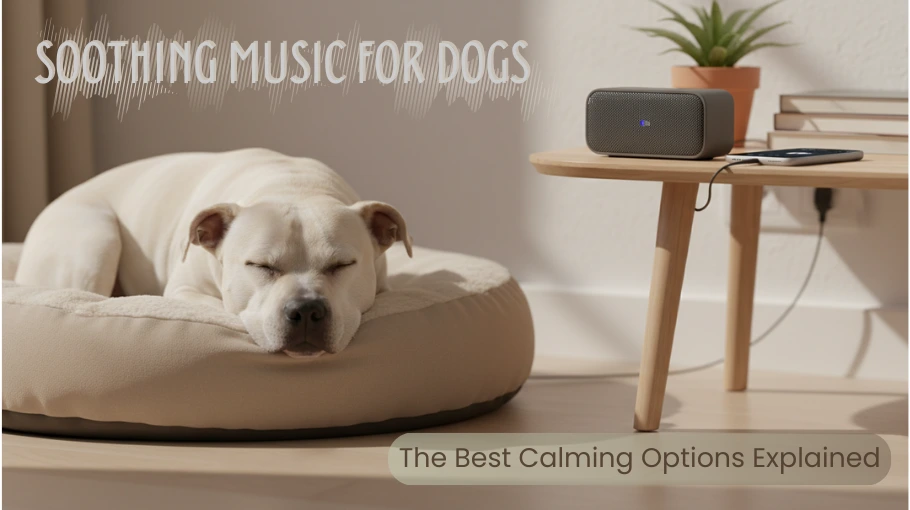
When you’re looking for soothing music for your dog, chances are you need something that works right now—whether it’s for fireworks, a stressful moment at home, or simply helping them unwind.
The trouble is, “calming dog music” is a mixed bag online. Some videos help. Some don’t. And some are packed with ads that ruin the whole effect.
Instead of sending you on a long hunt, this guide shortcuts the process.
Rather than giving you random playlists, it points you straight to the most reliable calming options, depending on what you’re using in the moment:
- On your phone (quick access on the go)
- On your TV (ideal for dogs who like visuals too)
- On a Bluetooth speaker (perfect for crate-time, bedtime, or travel)
Each option has its own strengths, and the right one depends on your dog and the situation.
Discover the Most Calming Music for Restless Dogs
Do Soothing Sounds ‘Really’ Calm Dogs Down? (The Short Answer)
Yes… certain sounds really do help dogs relax.
The research is surprisingly consistent: dogs calm down fastest when the music is slow, simple, and low-frequency, especially pieces that resemble gentle classical compositions.
These types of sounds lower pacing, reduce agitation, and help dogs settle more easily. And it’s not based on clever marketing… there’s solid research showing which sounds genuinely help dogs relax.
What Type of Music Works Best for Dogs?
Several well-designed studies have shown that tempo, pitch, and complexity make a noticeable difference in how quickly a dog relaxes.
Research led by Dr Deborah Wells showed that dogs in shelters became noticeably calmer when exposed to simple, low-intensity classical music. They paced less, rested more, and showed fewer signs of agitation compared to other types of sound.
A broader 2020 review on the calming effects of classical music in dogs backed this up, showing that classical music consistently reduces stress indicators in dogs — particularly in noisy or overwhelming environments such as shelters or fireworks-heavy nights.
Another controlled experiment on how dogs respond to tempo and pitch showed that dogs are more likely to lie down, stay quiet, and settle when these sounds are played. Higher-pitched or fast, complex pieces were less effective.
And, in a Kogan et al. study comparing classical music, heavy metal, and dog-specific tracks, the results were unmistakable:
- Heavy metal increased agitation
- Dog-specific calming compositions helped, but
- Classical music with slow, steady rhythms consistently produced the strongest calming effect
Taken together, the research points to a clear pattern:
Dogs relax best to slow, simple, low-frequency classical-style music, especially when the sound is gentle, predictable, and free from sudden changes.
With those in mind, and the classical melodies that worked for our pups, only a few select curations perform reliably.
Best Soothing Music Options for Dogs (My Top 3 Picks)
To keep things simple, I’ve narrowed it down to three options that cover almost every scenario — quick access on your phone, a calming setup on the TV, or ad-free audio on a speaker.
🥇 Relax My Dog — Best Overall for Most Dogs

🟢 Best For
Dogs who need long calming sessions (solo time, car journeys, workday length), and dogs who benefit from variety rather than the same sound on repeat.
⭐ Why It’s the Best
Relax My Dog has been around for years and has a huge library of slow, simple, calming tracks that match exactly what research shows helps dogs relax. Their playlists are refined based on long-term feedback from millions of dog owners, and you can try everything free on YouTube before committing to anything paid. Most tracks run 8–12 hours, which is ideal when your dog needs a full stretch of background calm.
📌 Cliff Notes
- Free long-form tracks available on YouTube
- Huge variety of calming playlists
- 24/7 live streams for continuous play
- Optional ad-free access (YouTube Premium or RelaxMyDog.com)
- MP3 downloads available on DogMusic.co for offline, distraction-free use
- Great for dogs who need consistency or variety
- Easy to run on phones, TVs, speakers, smart devices
⚠️ Cons
- YouTube ads are the biggest downside (they can be loud or jarring if you don’t have Premium)
- Paid options needed to remove ads
- MP3s take a little setup if you want continuous playlists
- Some reactive dogs may respond to the visuals on YouTube videos (MP3s avoid this)
💬 My Take
We first used Relax My Dog when our two Staffy pups were around eight months old, and it worked so well that I ended up setting up a spare phone and a Google Nest as a dedicated “calming station.” The MP3s became my go-to for holidays or longer outings because there are no ads to break the calm.
It’s not a magic fix for behaviour issues, but when paired with training it works incredibly well. I used the cue “chill” every time I played the music. Now, when I say “chill,” they automatically start settling — the music reinforces the routine.
If your dog needs long, uninterrupted calming sessions or you want a reliable option you can start for free, Relax My Dog is the best place to start.
👉 Learn more on RelaxMyDog.com (plain link — upgrade when you add tracking)
👉 MP3 downloads available at DogMusic.co
🥈 iCalmPet — Best Science-Backed Option

🟢 Best For
Owners who want calming music that’s built on research rather than “nice sounding playlists,” and anyone who prefers one-time purchases (MP3s) over subscriptions.
⭐ Why It’s the Best
iCalmPet’s music is engineered using psychoacoustic principles — the same science used to influence relaxation and emotional regulation in people. It’s created by sound researcher Joshua Leeds, building on work from Dr Alfred Tomatis (a pioneer in auditory processing research).
What you get is calming audio that’s been specifically shaped for dogs’ hearing ranges, stress responses, and sound sensitivities — not just classical music repackaged for pets. Their MP3 albums work without ads, interruptions, or screen distractions, and can be played on any Bluetooth speaker, smart device, or phone.
📌 Cliff Notes
- Created by sound researchers, not generic playlist makers
- Designed using proven psychoacoustic methods
- Available as MP3s for offline, ad-free listening
- Works for both dogs and cats
- No subscription required
- Optional portable speaker with 10–25 hours playtime
- Human relaxation tracks also available (though not the same as dog-specific ones)
⚠️ Cons
- The optional Bluetooth speaker is an extra cost
- Smaller library compared to big subscription platforms
- MP3 albums are less “plug-and-play” than YouTube-style content
- Best results still depend on your dog’s individual sound preferences
💬 My Take
I haven’t used their physical speaker, but I have used MP3 albums from similar science-based producers — and they work brilliantly for creating a calm environment without relying on a TV screen or YouTube’s ad interruptions.
If you like the idea of research-driven calming audio, or if your dog settles better with sound-only (no visuals), iCalmPet feels like a strong, reliable choice. It’s also great for travel or crate-time because you can play it from any device without worrying about WiFi or adverts kicking in at the wrong moment.
👉 Visit the iCalmPet store on Amazon
🥉 DogTV — Best for Dogs Who Like Visuals Too

🟢 Best For
Dogs who relax better with visual engagement as well as sound — especially those who get restless when left alone or need gentle stimulation to settle.
⭐ Why It’s the Best
DogTV was developed with help from animal behaviour experts and focuses on calming visuals paired with gentle audio. Instead of playlists or music alone, it uses slow movements, soft colours, and familiar soundscapes (like parks, beaches, or quiet indoor scenes) to create a soothing, dog-friendly environment. It’s designed for dogs who naturally watch screens or become calmer when there’s something steady and predictable to look at.
📌 Cliff Notes
- Created with animal behaviour specialists
- Combines calming visuals and gentle audio
- Helps some dogs feel less anxious when alone
- Available on Smart TVs, apps, and streaming devices
- Includes relaxation, desensitisation, and gentle stimulation programs
- Offers variety beyond just music-based solutions
⚠️ Cons
- Subscription-based, so it may not suit all budgets
- Some dogs ignore screens completely
- Reactive dogs may respond too strongly to moving shapes or animals
- Content library is smaller than general streaming platforms
💬 My Take
I haven’t used DogTV personally, but I’ve used similar calming content — mainly Relax My Dog — with good results. Our late Staffy, Flash, wasn’t an anxious dog, but he loved watching TV, especially anything involving balls. He’d happily watch football or tennis for ages if we let him.
DogTV feels like the more polished, purpose-built version of that experience. Whereas Relax My Dog is mostly about sound, DogTV builds the visuals into the calming effect. For dogs who genuinely enjoy watching screens, or who settle better with gentle movement in the background, it can be a great fit.
👉 Visit dogtv.com to learn more
Comparison: Relax My Dog vs iCalmPet vs DogTV
| Feature | Relax My Dog | iCalmPet | DogTV |
|---|---|---|---|
| Best For | Long calming sessions, variety, trying free options first | Owners who want research-engineered, sound-only calming | Dogs who respond to visual stimulation as well as sound |
| Format | YouTube videos, live streams, MP3 downloads | MP3 albums, optional portable speaker | TV-style video programming for dogs |
| Science Basis | Based on user feedback and calming acoustic patterns | Built using psychoacoustic principles and auditory research | Developed with behaviour experts for sensory engagement |
| Works Offline? | Yes (MP3s) | Yes (MP3s) | Depends on app/device and downloads |
| Subscription Required? | No (free on YouTube) — ad-free needs Premium or RelaxMyDog.com | No — one-time MP3 purchases | Yes — monthly or annual subscription |
| Ad-Free Option | YouTube Premium or RelaxMyDog.com | Always ad-free | Ad-free as part of the paid service |
| Library Size | Very large (8–12 hour tracks and live streams) | Smaller but highly curated | Moderate; focused on relaxation, exposure, stimulation |
| Screen Required? | Not for MP3s (ideal for reactive dogs) | No | Yes — TV, tablet, or streaming device |
| Portability | MP3s work on phones, speakers, TVs | MP3s plus optional long-life speaker | Limited to supported apps/devices |
| Strengths | Huge variety, free entry, long tracks | Strong scientific foundation, no ads, no subscription | Ideal for dogs who enjoy visuals or need gentle stimulation |
| Weaknesses | Ads unless paid; MP3 setup needed | Smaller catalogue; extra cost for speaker | Not compatible with all smart TV brands. May require browswer use and phone casting |
Relax My Dog
- Best for: Long calming sessions, variety, and trying a free option first.
- Format: YouTube videos, live streams, and MP3 downloads.
- Science basis: Refined over years of user feedback and calming acoustic patterns.
- Offline use: Yes, via MP3s.
- Subscription: Not required for YouTube; ad-free needs Premium or RelaxMyDog.com.
- Strengths: Huge library, long tracks, easy to test for free.
- Weaknesses: Ads on YouTube unless you pay; MP3 playlists need a little setup.
iCalmPet
- Best for: Owners who want research-driven, sound-only calming.
- Format: MP3 albums, with an optional portable speaker.
- Science basis: Built using psychoacoustic principles and auditory research.
- Offline use: Yes, via MP3s.
- Subscription: No — one-time purchases instead.
- Strengths: Strong scientific foundation, ad-free, no subscription needed.
- Weaknesses: Smaller catalogue; speaker adds extra cost.
DogTV
- Best for: Dogs who relax better with visuals as well as sound.
- Format: TV-style video programming for dogs.
- Science basis: Developed with animal behaviour experts for sensory engagement.
- Offline use: Depends on the app/device and downloaded content.
- Subscription: Yes — monthly fee.
- Strengths: Great for screen-watching dogs that benefit from gentle visual stimulation.
- Weaknesses: Only helpful if your dog actually watches screens; needs compatible devices.
When Should You Use Calming Music for Dogs?
Calming music isn’t just for anxious moments — it works best when you use it deliberately, in everyday situations where your dog naturally struggles to settle. Here are the most practical times to use it:
• When your dog is home alone
A gentle, predictable sound in the background can reduce the feeling of being “suddenly alone,” especially for dogs who find solo time difficult. It adds familiarity and routine to the environment.
• During fireworks, storms, or sudden loud noises
Calming music can help soften the impact of unpredictable sounds — but it’s important to be clear about how to use it.
Noise desensitisation is incredibly useful, but it must be done gradually, at very low volumes, and weeks before fireworks season.
If fireworks are already going off, that is not the moment to play loud bangs or “realistic” firework tracks on your TV or phone — that can make things worse.
Use soft, soothing music only in the moment, and keep desensitisation training to controlled, calm practice sessions long before the real thing.
• Before downtime, crate-time, or quiet-time routines
Playing calming music before rest helps your dog predict what’s coming next. If you already use a cue like “chill,” (my go-to for quiet time training) the music becomes part of the settling routine.
• For hyperactive moments or over-arousal
Some dogs struggle to “switch off” after play or excitement. A calming track in the background can help lower the overall mood of the room and support your settle training.
Music is best paired with other ways to handle hyperactive dogs, lowering the energy levels faster.
• Car journeys
Music can help buffer against engine noise and movement, especially for dogs who get tense or drool when travelling.
• After vet visits or during recovery
Soft background music helps create a low-stress environment, especially if your dog is resting after an emotional or physically draining experience.
• In new or stimulating environments
If you’re staying somewhere unfamiliar — holiday cottages, hotels, visits to family — familiar calming music gives your dog a “home base” sound that helps them settle.
How to Use Music to Calm Your Dog (Simple Routine)
Most dogs don’t automatically relax just because calming music is playing — they need a clear, predictable routine that teaches them what the music means.
Here’s a simple way to turn calming music into a cue your dog recognises and responds to.
1. Choose a settling cue (optional but very effective)
It can be anything short and calm:
- “Chill.”
- “Settle.”
- “Time to rest.”
Say it once, softly, every time you start the music.
Over time, your dog connects the word + sound with the feeling of resting.
2. Keep the environment calm when you turn the music on
Calming music works best when:
- toys are put away
- no exciting interactions follow
- you’re not hyping the dog up
- there’s somewhere comfy to lie down
The goal is to help your dog shift gear, not go from 100mph to zero in one second.
3. Start with short sessions (5–10 minutes)
If your dog isn’t used to settling:
- start small
- keep the music low
- reward the feeling of settling (calm breathing, lying down, sighing)
Small wins compound quickly.
4. Build the association before you need it
This part is huge.
If the only time your dog hears calming music is when:
- fireworks are going off
- they’re alone
- they’re anxious
- they’re overstimulated
…they won’t associate the music with calm.
Instead, build the routine on quiet, easy days first.
That way, when you do need it, the association is already in place.
5. Use music during predictable transition points
Dogs settle far better when they know what’s coming next.
Great times to use calming music:
- before crate-time
- after a walk
- while you’re working at home
- when guests leave
- during the evening wind-down
This helps turn the music into a signal, not just background noise.
6. Keep the volume low and steady
Think of it as a sound blanket, not a sound barrier.
Too loud creates tension; too quiet makes no difference.
Aim for:
Volume low enough that you can talk normally over it.
7. For dogs with separation anxiety, make it part of the exit routine
For mild cases:
- turn the music on
- give a scatter of treats or a long-lasting chew
- leave calmly, without a fuss
Consistency matters more than the length of the track.
👉 Understanding Separation Anxiety in Dogs
8. Use longer tracks or playlists for longer downtime
This is where your product roundup ties back in:
- Relax My Dog → long 8–12 hour tracks
- iCalmPet → MP3 albums with no ads
- DogTV → great for visual dogs left alone
Once your dog understands that calming music means “time to settle,” it becomes an incredibly useful tool — simple, gentle, and something you can use anywhere.
Wrapping Things Up
Calming music is one of those simple tools that can make a noticeable difference to a dog’s day-to-day wellbeing. The research is clear: dogs settle best to slow, gentle, low-frequency sounds — and when you build that into a predictable routine, it becomes something they genuinely lean on.
Each option in this guide supports that goal in a slightly different way.
- Relax My Dog is ideal for long, steady background sessions.
- iCalmPet offers a more scientific, sound-only approach without interruptions.
- And DogTV is perfect for dogs who relax better when there’s something to engage their visual senses as well as calming audio.
If your dog struggles with noise sensitivity, restlessness, or winding down after excitement, calming music is an easy, low-effort way to help them feel safe and settle faster. It’s gentle, it’s flexible, and you can use it anywhere — at home, in the car, when travelling, or as part of a quiet-time routine.
Over to You…
Have you ever tried calming music with your dog? Maybe during fireworks, when they’re home alone, or as part of your own quiet-time routine? I’d love to hear what’s worked for you — whether it’s one of the options in this guide or something completely different.
Share your experience in the comments below.
This was such a thoughtful and informative read! Music therapy for dogs with anxiety is a topic I hadn’t explored much until now, and I really appreciated how clearly you explained the calming effects of different types of music. It’s fascinating to think that classical and soft instrumental music can have such a soothing impact on our canine companions. I also liked that you included practical tips for introducing music therapy into a dog’s routine, especially for pups who struggle with separation anxiety or loud noises.
I can definitely see how this could make a real difference in a dog’s well-being, and it’s wonderful to see more pet owners embracing holistic methods like this. Have you found that certain breeds respond more positively to music than others?
Thanks Laura. My experience is limited to Staffies, however, from the user reviews of each of them, it seems like it’s universal to all breeds. I was curious myself about that, which is why I dove into the science of it. I was surprised by the number of studies done on the topic.
What breed do you have, and is it anxiety you’re having bother with, or just the loud noises frightening the dog? The problem dictates the approach to take. If it’s the latter of loud noises, it’s desenensitation tracks that’ll help most.