
How to Walk Your Dog at Night Safely
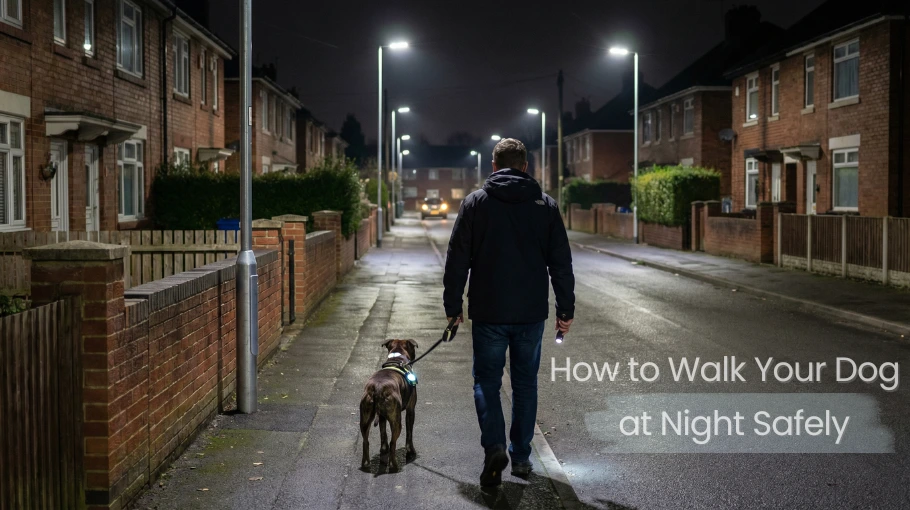
Night walks can be one of the quietest parts of the day — fewer people, calmer pavements, and a nice way for you and your dog to settle before bed. But once the light drops, everything shifts. Shadows hide things you’d normally spot, sounds travel further, and dogs react a touch quicker.
You don’t need to overhaul your routine to make night walks feel safe. A few steady habits around visibility, route choice, and calm lead control make the whole walk smoother and far easier to enjoy.
Nighttime Dog Walking Safety Tips
Why Night Walks Need a Little Extra Care
Obviously, there’s less vision. But the bigger issue is that you don’t always realise what’s around you until it’s already happened.
I’ll give you an example. Years ago, one of our Staffies was sprinting off-lead through open countryside. Out of nowhere he yelped — loudly — and then to a quieter whimpering. We could hear him, but we couldn’t see him anywhere.
Thankfully, our other dog led us over. He’d gone full pelt across the field and straight into a deep ditch he couldn’t climb out of. I ended up flat on my stomach hauling him back up.
And that was in broad daylight. In the dark, we’d have had no chance of finding him quickly.
Dark nights aren’t dangerous by themselves, but they do remove the visual cues we rely on. Even with a good torch, there’s still only so much you can see at once.
A few things change once the sun sets:
Reduced visibility for everyone
Drivers, cyclists, and walkers react to what they can see. A dog blending into the pavement or an unlit cyclist appearing from nowhere can catch anyone off guard.
Sounds feel sharper
Bushes rustle. Cats lurk then dart. Even calm dogs react a little faster at night because there’s less visual context.
Hazards hide in plain sight
Uneven kerbs, broken glass, dog mess — all the usual obstacles become harder to see.
Choose Routes That Feel Predictable and Safe
Route choice is the biggest factor in how comfortable a night walk feels. A familiar street at 10am can feel completely different at 10pm.
Stick to streets you already know well
When you know where the pavement dips, which corner feels tight, and which roads stay well-lit, half the uncertainty disappears. Your dog settles faster too because nothing feels “new.”
- Use well-lit, wide pavements when possible
Consistent lighting gives you more time to react. It also helps drivers and cyclists spot you long before they’re next to you.
Avoid tight cut-throughs and blind corners
These feel harmless in daylight but lose visibility after dark. Slow your pace, pause with a quick “wait,” and make sure the path is clear.
Town centres feel different once the pubs fill up
When I lived near a busy town centre, early evenings were fine. But once the pubs got lively, the crowds, noise and unpredictable movement made the dogs unsettled — and me, if I’m honest. On those nights I’d switch to a quiet residential loop instead. It wasn’t dramatic — just calmer, easier, and far more predictable.
Some nights, a short toilet break is enough
If your dog had a proper daytime walk and something feels off — rowdy streets, poor lighting, or you’re simply not comfortable — a short toilet trip can be the safer choice. Your comfort directly affects your dog. If you tense up, they’re scanning more, pulling more, and reacting quicker.
- Choose routes you genuinely feel good about
You never need a dramatic reason to avoid a certain street. If something doesn’t feel right, change direction. Your dog relaxes more when you feel steady and in control.
Keep Your Dog Visible (And Why It Matters More Than Anything Else)
Visibility is the number one safety factor after dark. A dog appearing out of the shadows can surprise walkers, cyclists, or drivers — even when everyone is paying attention.
A dog light is the biggest game-changer
Reflective gear only works when something shines at it. A dog light works all the time.
They’re especially helpful if your dog:
- has dark fur
- walks near roads
- goes off lead anywhere
Surprisingly, the best dog lights for safe night walking can be as simple as an LED necklace.
Reflective harnesses and leads still help
They’re not a replacement for lights, but they make your dog easy to pick up in torch beams, headlights, or bike lights. If your dog goes off lead at any point, a light is essential. On simple on-lead pavement walks, reflectives are the minimum.
Clip the light where it won’t get buried in fur
Lights work best on:
- the collar
- the front of the harness
- angled slightly forward
A quick 2-second on/off test before you leave prevents a lot of frustration.
- Lights prevent dog–dog surprises
In darker parks or unlit paths, a dog without a light can startle yours — even friendly dogs bark when surprised. Visibility lets both sides adjust before they meet.
Make Sure You’re Visible Too
Your visibility matters just as much as your dog’s. If others can see you early, they have time to slow down, step aside, or put their dog on lead.
Carry a reliable torch
A small torch cuts through shadows where hazards hide: glass, potholes, dog mess, uneven kerbs. I tend to lower the beam slightly when someone approaches so I’m not dazzling anyone.
I’ve a small zoomable torch that slots into the dog bag, and it’s by far the best zoomable torch I’ve used. Plenty of brightness without the bulk.
Walk against the traffic
When there’s no pavement, facing oncoming cars gives you far more control — you can see what’s coming, shorten the lead early, and keep your dog on the inside where they’re safest.
It also stops that uneasy feeling of constantly checking over your shoulder; everything you need to react to is right in front of you.
Even on pavements, it often feels more natural to walk toward traffic. You can guide your dog away from the kerb before a car passes, and there’s no ambiguity about whether you’ve seen the vehicle approaching.
From a driver’s perspective, that small bit of clarity makes passing you far less stressful. It’s a simple, courteous way to reduce uncertainty for everyone and keep the walk calm, predictable, and safe.
- Add a reflective detail
You don’t need to glow. A single reflective strip on a jacket, hat, or bag is enough for headlights to pick up.
- Hands-free options for short moments
I use an adjustable lead that I can clip around my waist when I need both hands free for a few seconds — usually when tying a bag or holding the torch on uneven ground. It’s not for hands-free walking; it’s just a practical way to stay steady when you need to sort something out.
It’s also one of the best dog leads for large dogs because you can leverage your body weight to control pulling, rather rely on arm strength.
Lead Control and Commands That Matter After Dark
Dogs react quicker at night because the world “sounds” busier and looks less defined. Good lead control turns that extra alertness into something manageable.
Shorter leads give you more control
Long lines and extendables may be great tools, but at night they can cause:
- tangles
- tripping
- delayed reactions
- sudden lunges into shadows
Use a normal lead for unlit pavements or anywhere with limited visibility. Save long lines for well-lit fields or daytime.
Use the core commands that matter at night
Our dogs were trained with these — they’re ideal for night walks. We just worked them into the regular commands they were being taught. Helped to mix it up too. Keeps them thinking.
- “In” — bring them closer on narrow pavements
- “Wait” — pause at kerbs or blind corners
- “Go” — a release cue we use when crossing roads
- “This way” — to redirect from peoples gardens, past lanes, or to keep their attention when someone else has a dog on the opposite side of the street.
Consistent cues make the whole route smoother.
Anticipate sudden surprises
At night, dogs often react to:
- wildlife in bushes
- joggers passing close
- bins or fences rattling in the wind
- unlit cyclists
- loose dogs appearing suddenly
A steady tone and a quick “wait” keeps everything controlled.
- Your steadiness becomes their steadiness
Dogs read your posture instantly. If you stay balanced and calm, they settle into the same rhythm — especially Staffies, who mirror their owner’s energy closely.
Keep Your Hands Free and Organised
Night walks need a touch more coordination. Between torches, leads, and clean-ups, being organised makes everything easier.
- A small walking bag makes a big difference
Separate compartments mean you can reach:
- bags
- torch
- wipes
- treats
- phone
…without rummaging in the dark.
There’s different styles of walking bags. My preference is a standard crossbody bag, but there are specific dog walking bags with dedicated compartments for most items you’ll reach for.
- Use waist-clipped leads for short, controlled hands-free moments
If I’m picking up mess, holding the torch, or steadying myself on uneven ground, clipping the lead around my waist keeps the dogs anchored. It’s not for walking hands-free — it’s just a safe way to free both hands when needed.
Phone Safety, Battery, and Personal Awareness
Phones are brilliant backup tools, but only if the battery is there when you need it.
- Use your phone as backup, not entertainment
Your phone might need to be:
- a torch if your main one fails
- a map
- a way to call for help
Limit battery drains like long podcasts, fitness apps running constantly, or bright screens.
- Avoid earphones
Even bone-conduction ones reduce awareness enough to miss:
- approaching bikes
- joggers
- loose dogs
- wildlife
Night-time sound really matters.
- Tell someone your rough plan
It doesn’t need to be formal. A simple “heading out, back in 20” to someone at home gives a safety net if something delays you.
Quick battery-and-light check
- Phone charged
- Torch working
- Backup phone torch tested
That’s enough.
Weather Changes How Night Walks Feel
Different weather affects visibility, sound, and how your dog walks.
Rain hides hazards
Wet pavements reflect light and make glass, dips, or kerbs harder to see. Aim the torch slightly ahead.
Fog reduces visibility
Even bright dog lights look dimmer. Stick to well-lit pavements and shorten the route.
Frost and ice change footing
Frost and ice change how confident some dogs feel on the ground. If your dog slows down, seems hesitant when you bring the lead out on cold mornings, or lifts their paws more than usual, it may be the weather drying their pads out.
Paw balm can help protect against cracking and soreness after cold-weather walks. If that feels like it’d make your night or early-morning walks smoother, here are some of the best paw balms for dogs worth considering.
Wind makes dogs more alert
Scent travels quickly, bushes rustle, bins rattle — even confident dogs become more reactive in gusty weather. A shorter, predictable route is usually easier.
- Adapt the walk to the weather
Rainy → wide pavements
Foggy → avoid fields
Icy → slow and steady
Windy → expect quicker reactions
Little adjustments make the walk far more relaxed.
Wrapping Up:
Night walks don’t need to feel risky. Once you build simple habits around visibility, steady control, and predictable routes, they become one of the calmest parts of the day.
Some evenings will be windy, some foggy, some filled with odd noises from the hedges — but with the basics in place, you’re prepared for all of it. Your dog walks better when you feel in control, and most of that comes from the small decisions you make before you even step outside.
Choose routes you feel good about, light the way, and keep your dog close when it matters. Do that consistently, and night walks become what they should be: a quiet, reliable end to the day that both you and your dog can enjoy.