
Potty Training with a Crate: Calm, Simple, Effective
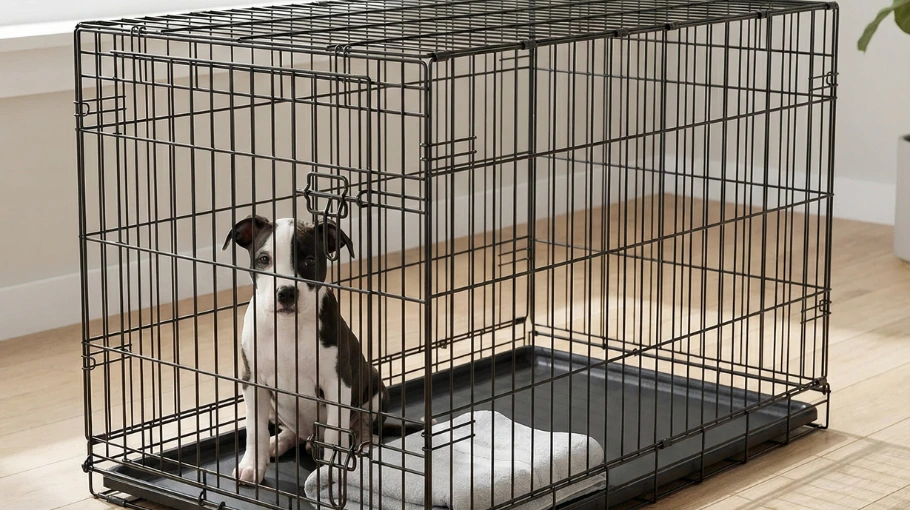
Soon after the honeymoon period of bringing a puppy home begins the transition from training pads to real potty training — getting your dog to tell you it needs out, not just choosing a corner of the crate because it hasn’t yet figured out how to communicate with you.
An advantage of potty training with a crate is how clearly it helps your puppy connect the dots between “I need to go” and “I want out.”
It removes the guesswork, helping your pup learn to signal instead of silently finding a corner.
But the part many new pup parents hit a wall with is telling the difference between “I need to go” and “I want out.”
Early on, your puppy won’t know how to tell the difference either. Whining, barking, pacing, or pawing at the crate door can mean either one.
Some dogs are restless because they genuinely need to relieve themselves; others simply want company or playtime.
That’s why the first phase of potty training with a crate is as much about observation as it is about routine. You’re learning your pup’s language — those little signals that come before an accident.
Sniffing the bedding, circling, or going quiet and focused for a few seconds are often the real clues.
Once you start spotting those patterns, you’ll know when the whining means “toilet trip” and when it’s just impatience.
There’s a balancing act here: give in too easily, and they’ll take longer to settle; leave them holding it too long, and they may start to fear the crate.
Whether you’re in the planning stage of potty training or you’ve realised a crate might save you from another morning scrub, expect a few hiccups early on.
All you need to know about potty training with a crate
Why Crate Training Works (and How to Set Up for Success)
Dogs naturally avoid soiling where they sleep — it’s part of their den instinct. A crate builds on that behaviour, teaching your puppy where to rest, where to play, and where not to toilet. When used the right way, it becomes a space for calm and structure, not confinement.
That’s why crate setup matters so much. Too much room too soon, and your puppy will do what comes naturally — find a corner for toileting and another for sleeping. Once that habit starts, it’s harder to undo. A properly sized crate prevents that from ever taking hold.
Choose the Right Size (and Use the Divider)
Start with just enough room for your puppy to stand, turn around, and lie down — very limited extra space. That small area helps them learn to “hold it,” because there isn’t a spare corner to use.
A divider is your best tool here. It lets you start small and expand the space as your puppy grows, keeping training on track without needing to buy a small crate for potty training only to need another one later to fit your dog as it grows.
🎬 Matt Covey of Suburban K9 demonstrates this perfectly with a tiny pup in a crate that’s too big, then the divider added to solve the issue.
(The thumbnail’s just for effect — that big dog doesn’t stay in there! Click play to see the puppy version in action.)

🎯 Helpful follow-up:
By pure coincidence, the crate Matt’s showing in that video happens to be the MidWest Homes for Pets Crate — the same one we used when our pups were learning. It’s sold as a complete kit now, with a cover and divider, making it ideal for early crate and potty training.
I’ve also featured it (alongside travel and escape-proof options) in my roundup of the best dog crates.
Add a Comfortable, Easy-Clean Bed
In the early stages, skip crate beds completely. A couple of blankets or old towels work best — they’re washable, inexpensive, and always fit even after you move the divider to give your pup more room.
We went with the throws our breeder gave us — blankets that carried the scents of the litter and familiar textures. Still comforting to them, no matter how many wash cycles they went through.
An added bonus of blankets or towels is that you’re getting them used to the padding. Add another one, and still, no amount of pawing is going to rip seams or spill stuffing everywhere. While they’re in the settling phase, beds are more hassle than you need.
As an aside, we found it helped to replace the blankets like-for-like when the threads became loose. Expect that, particularly with Staffies, as their chewing is more akin to gnawing. A cheap fleece throw blanket beats a 650 GSM bath towel for puppy bedding purposes.
Once your puppy stays dry overnight, you can move up to a water-resistant crate mat that wipes clean and folds neatly to fit the space.
Keep It Positive
The crate should always feel like a calm, safe space — never punishment.
Add a soft blanket, a safe chew (when supervised), or a stuffed KONG to make it inviting.
See What to Put in a Dog Crate for more ideas.
Encourage your puppy to rest there during quiet times so the crate becomes their go-to place for relaxation, not isolation.
See How to Calm a Staffy Pup Down: Quiet Time Training — daytime downtimes help normalise crate time.
Modern Potty Training vs. Old Myths
Years back, things were very different. For a start, crates weren’t as common — some people hadn’t even heard of them. When I was a kid, I’d join my neighbour on dog walks, and a few of his training tactics would be met with outrage today. But back then, that was just how people thought you taught a dog right from wrong.
There are still people who pass down that kind of advice — usually from lived experience rather than cruelty. And sometimes, yes, those methods worked in the sense that the dog stopped doing something. But the bigger question is, at what cost?
I always try to remember that age changes everything.
Back when we were juggling two Staffy pups and a senior on medication, it became clear fast — what feels like a stubborn puppy accident today can look completely different years later when your older dog has one for reasons they can’t help. Scolding one while being compassionate with the other doesn’t make sense to them. Consistency and calm correction do.
Old-School Potty Training Methods to Avoid
There’s no shortage of old advice floating around — especially from people who “always did it that way.” Some of it came from good intentions, but most of it misses what we now know about how dogs actually learn. Here are a few examples that pop up time and again.
Punitive Confrontation
Shouting, scolding, or sounding disappointed right after an accident might seem harmless, but it only teaches your puppy to hide future mistakes. Dogs live in the moment — they don’t link your reaction to the puddle, only to your tone. That fear can make them hold it too long or sneak off to another room to go next time.
Showing the Mess
Some owners used to bring the dog over to “see what they did” or point at the spot. It doesn’t help. Dogs don’t process that kind of cause-and-effect the way we do — all they understand is that you’re angry near something that already smells like them.
Physical Discipline
Back in the day, rolled-up newspapers were almost standard kit. A quick tap was meant to “teach a lesson.” In reality, it breaks trust and damages the bond you’re trying to build. You can’t teach confidence through fear — especially not to a young pup who’s still figuring the world out.
Isolation or Locking Away
Some people used to shut dogs away for a “time out” after accidents. The trouble is, most pups don’t connect the isolation to what happened — they just learn that being alone feels scary, which can undo crate progress and build anxiety.
That said, a calm, short reset can work when it’s clearly a choice, not an accident — like when your pup looks at you, heads for the rug, and goes anyway. The key is timing.
Dogs learn by association, so the response only makes sense if it happens right after the behaviour.
Keep time-outs brief: about one minute per month of age is plenty. Stay quiet, no scolding, and let them back out calmly. It’s not punishment — just a few quiet moments to settle and connect the dots.
Withholding Food or Water
Trying to stop accidents by limiting water is another one that does more harm than good. Proper hydration keeps their bladder healthy and helps you predict when they’ll need to go. Structured feeding times make sense; restriction doesn’t.
Paper Training Indoors Without Transition
Traditional “newspaper training” (the DIY training pads of yesteryear) often left puppies associating any soft surface — carpet, rugs, or mats — with being fair game. Pads can be helpful short-term, but they should always move gradually toward the door to teach your pup that outside is the real goal.
Without that step, dogs never learn that outside is where toileting should happen.
The Modern Potty Training Approach (Tested and Proven)
Modern training focuses on calm interruption, not correction. When you catch your puppy mid-accident, don’t shout. Interrupt gently — a quick “ah-ah” or “outside” — then guide them straight to the door to show them where they should go.
Always go with them, especially in the early stages — even if it’s raining. They learn fastest when they can link your cue, the action, and the praise that follows.
Timing is everything. Puppies have predictable windows:
- First thing in the morning
- After meals
- After naps or playtime
- Before bed
Each trip builds a rhythm, helping their body clock sync with your schedule — and your praise when they know they’ve done well. Soon enough, that “good boy” moment becomes its own reward — all tail wags, no treats needed.
Praise and reward within seconds of success. The quicker the treat follows the action, the faster they’ll learn to repeat it. As your pup gets the hang of it, fade the treats but keep the encouragement.
Setbacks happen — even to well-trained dogs. Consistency beats perfection. When they do slip up, clean thoroughly with an enzymatic cleaner, reset the routine, and keep moving forward. Every repetition of positive training builds trust — and that trust builds strong bonds.
At this stage, it’s all about mastering how to potty train your puppy to go outside — and handling the accidents that still pop up along the way.
Cleaning, Scent, and the Divider Advantage
Scent memory is powerful. Even faint traces of urine can mark a spot as the “go-to” area, which is why some puppies seem drawn back to the same corner over and over. Enzymatic cleaners don’t just mask smells — they break them down completely, removing the invisible cues that keep accidents repeating.
Inside the crate, space matters just as much as smell. A divider keeps the sleeping area small enough that your puppy won’t be tempted to use one end as a toilet. It also helps them learn to signal when they need out rather than going in their space.
Cleanliness builds the den instinct. When the crate stays fresh, it reinforces that it’s a resting zone — not a bathroom. Move the divider back gradually as your pup stays clean and confident. That small bit of structure teaches respect for their space and gives you a cleaner, calmer home in the process.
Cleanliness and structure go hand in hand. When your puppy learns that their crate stays clean and their toilet breaks happen on a rhythm, the rest of training becomes much easier. It’s the same principle that helps with night-time routines — you’re building habits that last.
Night-Time Potty Training with a Crate
Night-time training is where most new owners worry they’ll undo their hard work. Puppies can’t hold it for long in the early weeks, and no one wants to start the day with a mess or wake up to crying. The good news is, with a bit of structure, nights can settle quicker than you’d expect.
Here’s what worked for us.
We’d let the pups out for one last toilet trip before bed, then straight into the crate for the night. One of us handled the late-night let-out, the other did the early-morning shift — roughly six hours apart. It wasn’t forever, but it helped us get through those first months without constant interruptions or setbacks.
If you don’t have someone to share the routine, you can still make it work. Early on, a quiet middle-of-the-night break might help, especially for very young pups. The goal is to prevent accidents without turning 3 a.m. outings into playtime. Keep lights low, avoid talking too much, and take them straight out and back in.
A good rule of thumb: a puppy can usually hold it for one hour per month of age — up to around six hours total. Beyond that, you’re pushing their limits. Always check with your vet if you suspect medical issues, but for most, this guideline holds true.
Keep food and water outside the crate overnight, especially once your puppy’s bedtime routine is consistent. If it’s a hot night or your pup tends to wake thirsty, use a clip-on crate bowl for small sips rather than full bowls.
Occasional overnight accidents are normal — they’re not a step back, just feedback on timing. Adjust the schedule, stay calm, and carry on. The more predictable the nights become, the faster your puppy learns that the crate is for sleeping, not toileting.
Gradually Expanding Freedom
Once your puppy starts staying dry through the night and reliably signals when they need out, you can start giving them a bit more freedom. This stage isn’t about “ditching the crate” — it’s about teaching boundaries and responsibility in small steps.
A good guide is the same as what I mentioned for night-time training: roughly one hour of crate time per month of age, up to a sensible limit of around six hours. As they grow, move the divider back a little at a time, or open the crate door for short, supervised naps.
Start with freedom in one safe area, such as the living room or kitchen, while you’re nearby. Watch how they handle it. Are they calm, curious, or straight into mischief mode? If they stay relaxed, you’ll know the crate training has done its job — it’s given them self-control and the sense that they still have a “home base” to return to.
Teaching door signals also helps this stage go smoothly. Some pups paw at the door, others sit nearby, and a few learn to bark or whine softly when they want out. Reward that communication each time — it’s your dog’s way of asking politely.
Eventually, you’ll find that your crate becomes less of a training tool and more of a comfort zone — a space they choose for naps, not confinement. That’s the sign you’ve done it right: structure first, then freedom earned through trust.
Wrapping It Up
Potty training with a crate isn’t about strict rules — it’s about rhythm, patience, and small wins that build over time. Every pup learns at their own pace, and every owner fine-tunes the routine to fit their home. What matters most is consistency.
The more predictable the days and nights are, the faster those “lightbulb moments” start to happen.
Think of the crate as a teaching tool, not a cage. It’s there to help your puppy learn boundaries and build confidence — a safe space they choose, not one they’re shut in. When paired with calm handling, regular breaks, and a setup that feels comfortable, the crate becomes the foundation for a clean, happy home.
If you’re setting up your training space, there’s a couple of guides linked to below that’s likely to be helpful…
- Best Dog Crates for potty training — practical, easy-to-clean options with divider panels for training and growing pups.
- Best Dog Crate Beds — washable, comfortable choices that fit snugly without soaking up accidents. (and, can be swapped out when an accident happens – back to blankets for a night).
Keep your approach steady, your tone kind, and remember: every “good boy” moment is another step toward a well-trained, well-adjusted dog.
One of the 5 crate training benefits is how much it helps with potty training.
You don’t have to rely on it forever — the divider lets you gradually increase freedom, rewarding your pup with the “run of the house” once you’re both ready and that trust’s been earned.